Pakistani attacks in Kunar indicate a renewed conflict escalation

7 min read

CIR

CIR 's photo

Share Report

Content warning: This report contains links to graphic footage and descriptions of violence 

On 27 April 2026, Afghan media outlets operating in Afghanistan including Shamshad TV, TOLO News, and the state-run Radio Television Afghanistan (RTA), reported on Pakistani attacks in Kunar province. According to the BBC Dari, local Taliban officials reported around 50 civilian casualties, including women and children, resulting from attacks that appeared to have targeted the Sayed Jamaluddin Afghani University and residential areas nearby in Asadabad, the provincial capital. Reports varied, describing the attack as airstrikes, missile strikes or artillery shelling. 

In addition to the attacks in Asadabad, both state-run and independent media reported further Pakistani strikes against civilian areas in the Sarkano, Dangam, Shultan, and Munawara/Marawara districts of Kunar province. Footage shared by Zawia News, reportedly recorded on the immediate aftermath of the attacks in Sarkano district, depicted locals running through thick dust. Despite claiming civilian casualties in the area, Zawia News did not provide any indication of the number of victims. 

Shortly after the strikes, the Taliban’s deputy spokesperson, Hamdullah Fitrat, shared multiple [GRAPHIC] photos of injured children, reportedly as a result of the shelling, and a statement describing the incident as “artillery shelling using mortars and rockets” targeting multiple areas of Asadabad, as well as parts of Manogai District. Fitrat stated that “civilian residences, including Sayed Jamaluddin Afghani University, were deliberately targeted”, which resulted in the injury of 70 civilians, including women and children, among them 30 students,  four of whom were killed. Fitrat condemned the attack, calling it “a grave and inexcusable war crime, a blatant act of brutality, and a provocative action” by the “military regime of Pakistan.”

A statement issued by the Taliban’s Ministry of Higher Education condemned the attack and claimed that the missile strikes injured around 30 students and lecturers at the Sayed Jamaluddin Afghani University, while also causing damage to the university’s buildings and compound.  

While no official statement was issued by Pakistan regarding the attacks, the Ministry of Information and Broadcasting Fact Checker account on X accused Afghan media of manufacturing the story in an effort to “gain sympathy to cover up support by Afghan Taliban to Fitna Al Khwarij [referring to the Tehrik-i-Taliban Pakistan (TTP)].”


Verified damage to civilian infrastructure

Afghan Witness (AW) analysed and verified numerous pieces of evidence of shelling in Asadabad city. The majority of the verified damage was clustered around the Sayed Jamaluddin Afghani University and its immediate surroundings. The figure below shows the geolocated buildings with signs of shelling, including damage to walls, shattered windows, and destroyed vehicles.
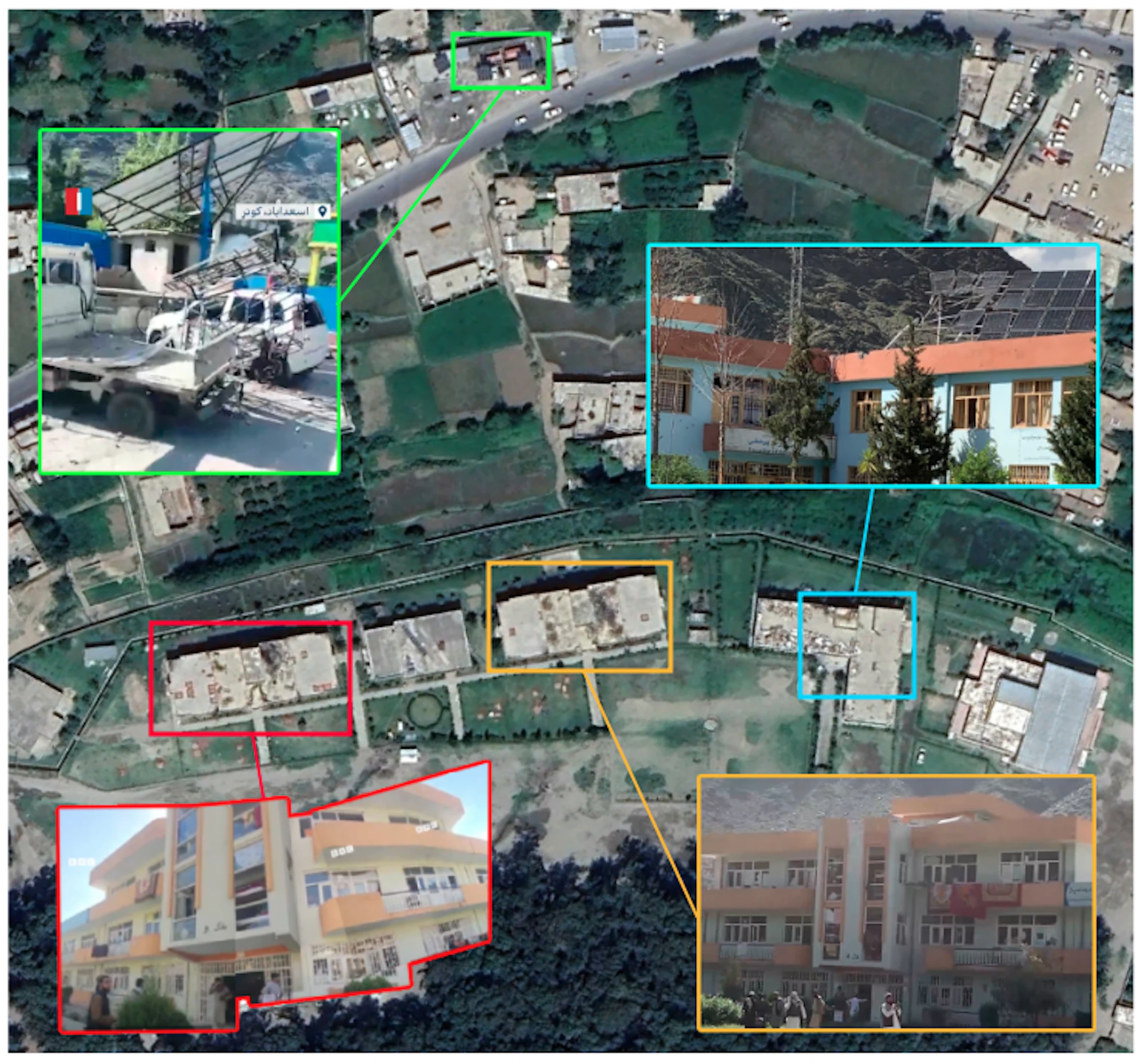
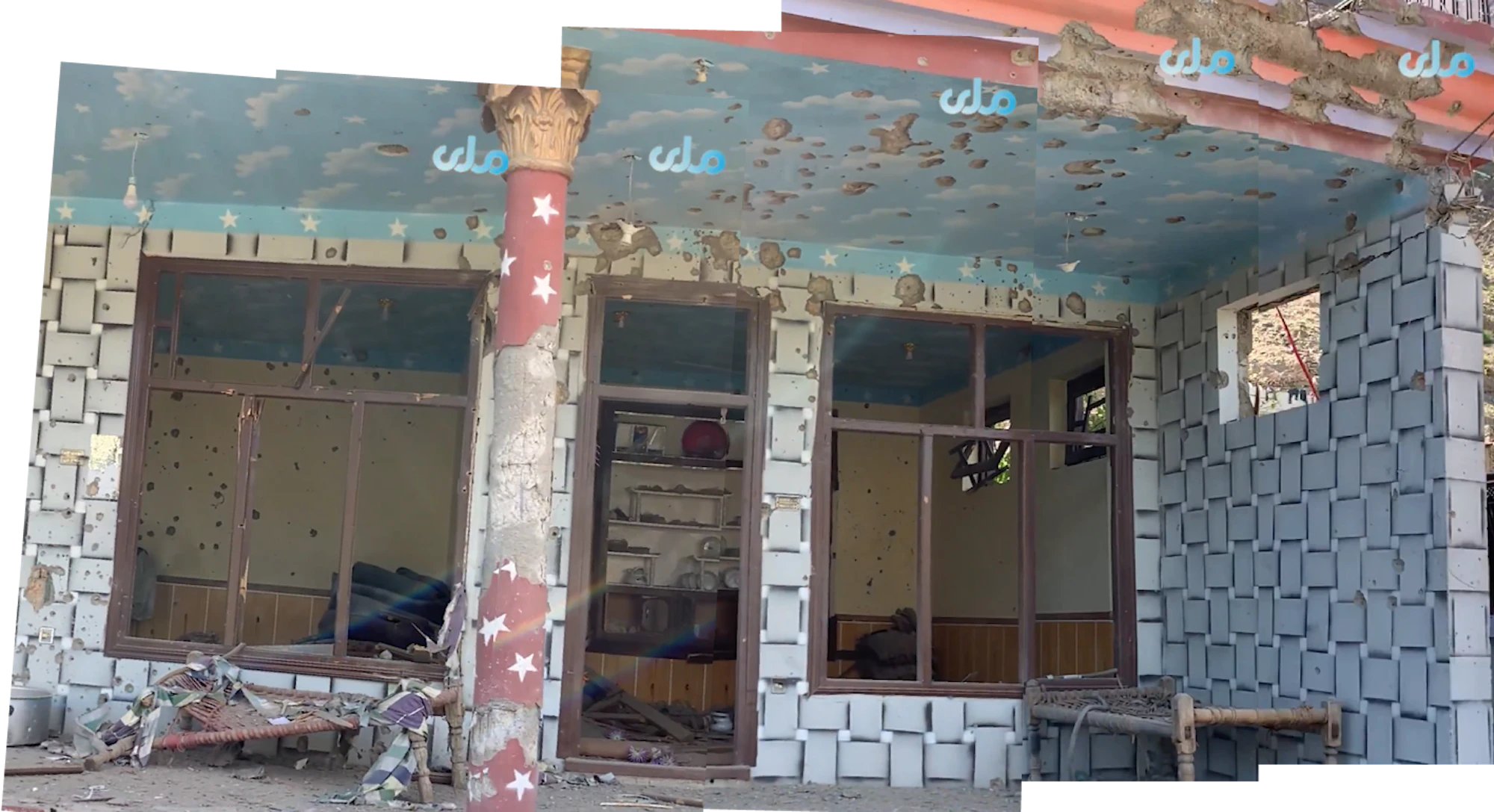
Figure 1: Geolocation of civilian infrastructure with damage likely caused by shelling in Asadabad, Kunar. In Green, a petrol station [coords: 34.859891, 71.137877], in red a university dormitory [coords: 34.858672, 71.139285], and in light blue, the Faculty of Education building [coords: 34.860098, 71.140166].

RTA and Zawia News shared footage of a residential property and a petrol station reportedly hit by a Pakistani strike in Asadabad. Footage of the household, seen in the figure below, indicates damage to both the exterior and interior of the building. Footage of the aftermath showed that the damage primarily appeared to be dispersed rather than concentrated, suggesting near misses or shrapnel effects rather than direct impacts on large civilian structures. This type of outcome is consistent with fragmentation originating from a ground-level detonation, possibly suggesting the use of rockets, artillery shells, or other surface-burst munitions. Direct aerial targeting of the area would likely have resulted in top-down visible damage to buildings and infrastructure which was not observed in the data collated through open source. However, due to reports of Pakistani jets and drones reportedly observed flying over Asadabad prior to the strikes, it is not possible to discard this hypothesis.

Figure 2: Damage to residential property allegedly located in Asadabad, on 27 April 2026.

Conventional mortars in the Pakistani arsenal are unlikely to have been able to deliver the strikes recorded in Asadabad, a city located nearly 14 Km from the border. Pakistani’s new 120mm AIMS mortar system, unveiled in September 2025, is their longest-range mortar. Their explosive shells are able to reach distances of 8 to 9kms under optimal conditions, therefore making it very unlikely this was the weapon of choice for the targeting of Kunar’s capital. 

It is worth noting that Pakistan is in possession of Howitzers, a type of artillery weapon designed to fire explosive shells in high arching trajectories, and capable of reaching a distance of over 14km. On 22 March 2026, ABN Pashto reported that a woman had been injured in the Naray district of Kunar province due to impact of a Howitzer shell during Pakistani strikes against the area. Given the reported use of tube artillery in the same province, and the infeasibility of long-range mortar fire, the damage observed in Asadabad is most consistent with the effects of a Howitzer type of weapon. However, due to a lack of evidence to confirm where the strikes originated from, it is not possible to fully confirm this hypothesis.


Potential military target near city centre

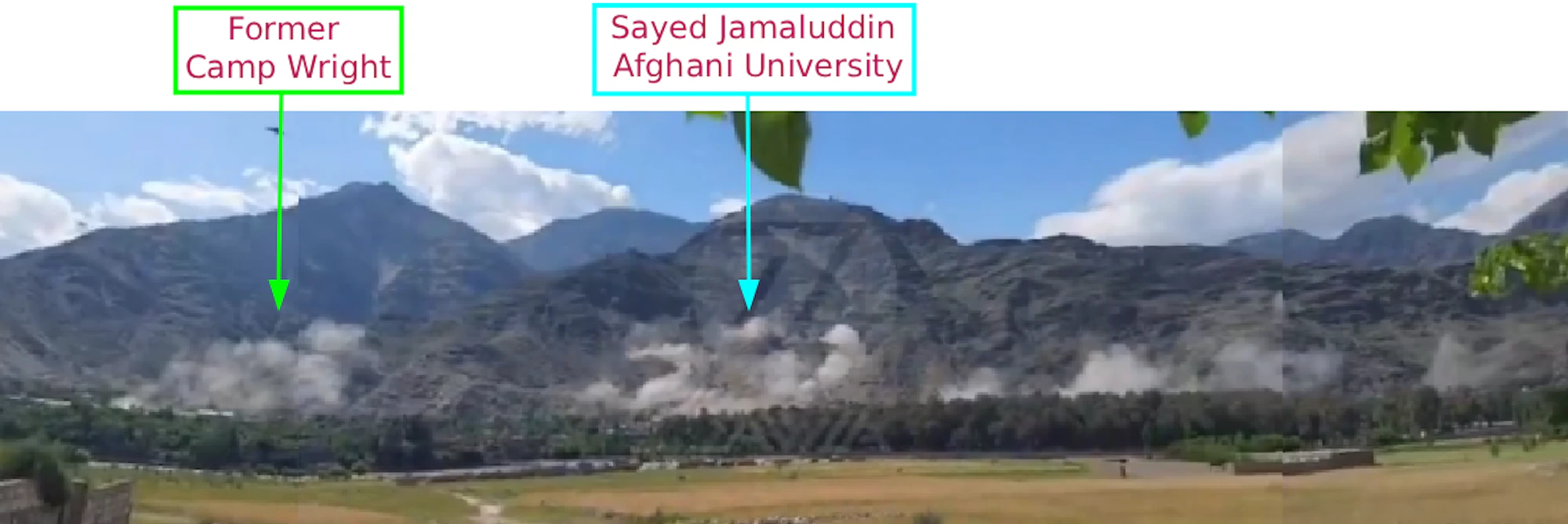
Given the proximity to a former US military base, Camp Wright, located less than 1km away from the university, it is possible that the civilian buildings and infrastructure were not the direct target but a byproduct of the attacks. A video shared by Zawia News, reportedly recorded immediately after the strikes showed smoke rising from various areas of Asadabad, as seen in the figure below. In the image, smoke is visible where the university is located, as well as to its left where the former Camp Wright is located. This is likely to be a result of similar strikes. Despite a lack of further photos or videos showcasing the damage to the former camp’s buildings, it is clear that the area was also shelled.

Figure 3: Panoramic image created from video posted by Zawia News showing smoke rising from various locations in Asadabad following alleged Pakistani strikes on 27 April 2026.

Reported civilian casualties

Following the incidents, AW verified footage shared by Shamshad News, of ambulances at the Asadabad Provincial Hospital (34.871039, 71.150871) 1.5 km from the verified incident locations. AW visually confirmed three likely deceased individuals (one adult and two minors) and 23 injured (10 adults and 13 minors, including [GRAPHIC] a baby). For all the injuries AW was able to visually verify, all but one adult (severely injured) appeared to have sustained minor injuries. None of the casualties verified by AW could be placed at the scenes of incidents. According to the Kunar provincial government hospital, shared by BBC Pashto journalist Hafizullah Maroof, 7 people have been killed and 75 others wounded.

Meanwhile, on 28 April, the United Nations Assistance Mission in Afghanistan (UNAMA) stated on X that they have documented dozens of civilians killed or injured in the attacks in Asadabad, Kunar. 


Reported attacks by Pakistan in Kandahar and Paktika

The attack against various districts in Kunar province did not occur in a vacuum. On the same day, Tolo News reported that Taliban forces engaged in retaliatory attacks against Pakistani forces at the Spin Boldak-Chaman border in Kandahar after an alleged killing of an Afghan child labourer by Pakistan border guards at the border. According to Tolo News, Taliban forces killed six members of Pakistani forces on 26 April 2026, and seized four rifles and a body, followed by exchanges of artillery fire the next morning.

On 27 April, Shamshad TV also reported that Pakistani forces conducted attacks in the Luqman village of Spin Boldak in Kandahar, leading to retaliatory attacks by Afghan forces. According to Tolo News, the attacks carried out by Pakistan involved mortar firing. 

On 28 April 2026 Pakistan Today, a private Pakistani news media outlet, reported that military forces targeted several Taliban posts, namely Sarshan, Al-Marjan and Edhi, a vehicle, and “other installations”, in the Chaman sector, located in Balochistan, bordering the Afghan Kandahar province. Meanwhile, a Pakistani account on X shared alleged military footage of the attacks.

Moreover, also on 27 April 2026, Aamaj News shared footage of alleged Pakistani attacks targeting Taliban outposts in Paktika provinces across the Angor Ada border, reportedly following mortar firing from the Afghan side. According to information presented on the unverified footage, the strikes had taken place on 26 April 2026.


Continuing tensions

The day after the Asadabad attack, on 28 April 2026, Afghanistan International reported that Pakistan forces conducted attacks in the Khas Kunar district of the province, leading to civilians fleeing their houses in Hijratabad Camp and Shali Dhak area.

Shortly after, Zia Ahmad Takal, the Taliban Head of Public Communications at the Ministry of Foreign Affairs, posted on X that the Ministry summoned the Charge d’Affairs of the Pakistani Embassy in Kabul and handed him a protest letter regarding “the attacks by Pakistani forces on civilian targets and public facilities along the Durand Line in addition to the attack on the university in the Kunar provincial capital.” There was no acknowledgement or statement from the Pakistani government at the time of writing.


Conclusion

The available open source evidence indicates that on 27 April 2026 multiple strikes hit Asadabad city, Kunar province’s capital, resulting in multiple verified civilian casualties, including children, and damage to civilian infrastructure. This incident is a continuation of the ongoing tensions between the Taliban de facto administration and the Pakistan government and may represent another escalation from the latter. While attribution remain contested and no official Pakistani acknowledgement has been issued, the geolocated buildings, casualty verification, and analysis of the damage, appeared to suggest that the impact was most consistent with explosive fragmentation artillery shells, possibly fired from Pakistani Howitzers, rather than airstrikes or the use of mortars. The incident demonstrates the continued risk to civilians amidst the ongoing tensions between Pakistan and the Taliban.

Latest reports, direct to your inbox

Be the first to know when we release new reports - subscribe below for instant notifications.

Share Report