Taliban’s reported ban on family dining in Kabul
October 2025
On 13 August 2025, Obaidullah Baheer, an adjunct professor at the American University of Afghanistan (AUAF) and grandson of former jihadi leader Gulbuddin Hekmatyar, criticised on his X account the ‘raid’ by the Taliban’s Ministry of Promotion of Virtue and Prevention of Vice (MPVPV) ombudsmen’s on two restaurants in Kabul, allegedly targeted for allowing families with both male and female members to dine together. “Today, the ombudsmen raided and sealed Bukhara Restaurant and Yummy Restaurant. They protested that male family members are not allowed to sit together with their families. With national and city parks closed to families and now restaurants are also banned, where should families go?” Baheer wrote in his post.
In response to his post, an X user commented, ‘They (the Taliban) also said female waiter permanent,’ to which Baheer added, ‘or boys under 12.’ This exchange suggests that the restriction was linked to the absence of female waiters, rather than being a blanket ban on family dining in restaurants.
Some media outlets, including Afghanistan International, also reported on the same day that Taliban ombudsmen instructed several restaurants in Kabul not to allow men and women to sit together, even if they are married or family members.
Amid reports of Taliban’s ban on family dining together, several Kabul restaurants posted vacancies for waitresses, apparently to meet conditions that allow them to continue serving families.
On 12 August, Chehelseton Palace Restaurant in Kabul announced on Facebook vacancies for female waitstaff in its ‘family section.’ Then, on 7 September, the same restaurant advertised ‘separate salons for men and families,’ indicating that it continues to operate family sections.
A reply on 26 August to a customer’s comment on The Cafeteria Restaurant’s Facebook page in Kabul also suggests that some family sections remain open. When a female customer asked, “Are families still allowed to dine together, or have (men and women) been separated?” the restaurant responded, “The family sections are active, madam!”
In April 2023, the Associated Press reported that the Taliban had banned families and women from entering restaurants with gardens or open spaces in Herat. In the same report an official from the Propagation of Virtue and Prevention of Vice directorate in Herat, was quoted denying media reports that all restaurants were off limits to families and women. He clarified that the ban applied only to restaurants with green areas, such as a park, where men and women could meet.
While the Taliban appear to have tightened restrictions and imposed conditions on restaurant owners, such as hiring waitresses, and prohibiting unrelated men and women from interacting under the guise of being family, available information indicates there is no blanket ban on family dining in Kabul restaurants.
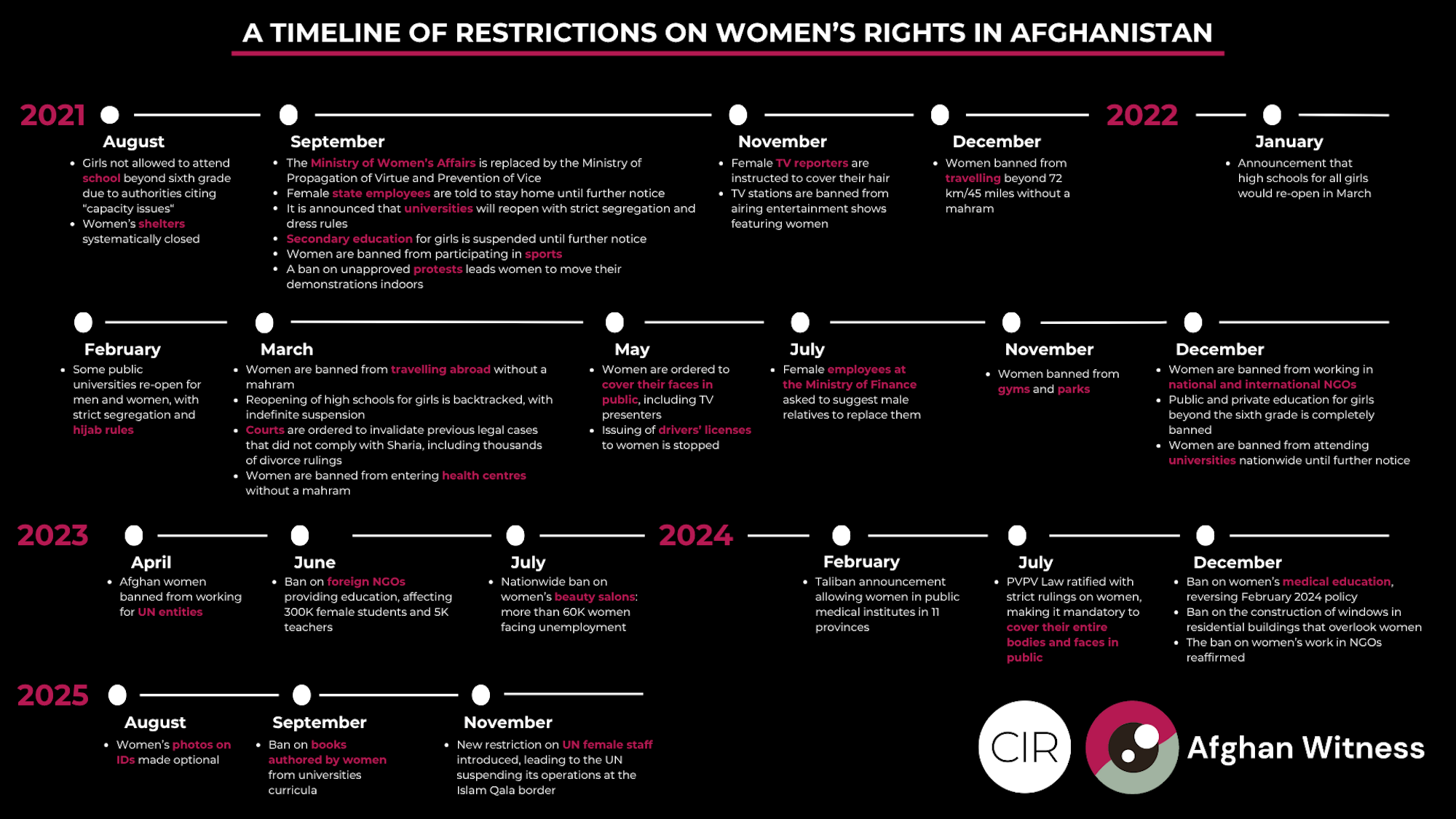
Women’s photos on national IDs made optional
October 2025
In late August 2025, activists and journalists circulated claims on X that Taliban Supreme Leader Hibatullah Akhundzada had ordered the removal of women’s photos from national identity cards. The allegations sparked widespread reactions from activists and anti-Taliban commentators. On 30 August, Sarah Adams, who claims to be a former CIA officer, responded to the reports, suggesting that the same rule should apply to female family members of Taliban officials. Adams also shared several posts containing copies of passports allegedly belonging to the wives of Taliban diplomats.
Conversely, Afghan media outlets reported that the Taliban had declared it optional for women to include photos on their national identity cards. In a report published on 30 August, Afghanistan International stated that the decision by the Taliban’s General Directorate of Central Dar-ul-Ifta followed a plan by the National Statistics and Information Authority (NSIA) to make women’s photos mandatory on IDs. According to Afghanistan International, which also shared images of official correspondence between the NSIA and the Dar-ul-Ifta, the NSIA had outlined eleven justifications for the proposal, including the prevention of identity fraud and other crimes. However, the Dar-ul-Ifta deemed ten of these reasons to be contrary to Sharia, accepting only the provision that women living abroad or travelling for medical treatment must have photos on their IDs. The report further noted that the Dar-ul-Ifta declared the inclusion of photos of women residing inside Afghanistan to be against Sharia.
Meanwhile, NSIA spokesperson Mohammad Halim Rafi told Rukhshana Media in an interview published on 15 September that the NSIA had sought guidance from the Taliban’s Supreme Leader, Hibatullah Akhundzada, who referred the matter to the Dar-ul-Ifta of Afghanistan for a final decision. Rafi added, “According to Dar-ul-Ifta’s decision No. 1075, the inclusion of a female image on the ID card is lawful and optional based on dire necessity.”
On 30 August, BBC Dari also reported that the Dar-ul-Ifta’s decision had been made in accordance with guidance from the Supreme Leader.
Reactions
The decision to make the inclusion of women’s photos on ID cards optional triggered widespread reactions from activists and prompted online campaigns such as ‘my photo, my identity’ and ‘Women are not invisible’. Women participating in these campaigns condemned the Taliban’s decision, describing it as an attempt to erase the identity of half the population.
However, on 31 August, the Killid Group (TKG), a media outlet operating inside Afghanistan, reported that some women welcomed the decision. One interviewee said she had previously been unable to obtain an ID card because her family did not permit her to have her photo taken, adding that the new decree would now allow her to receive an ID without including her image.
Context and conclusion
The gender gap in ID ownership in Afghanistan remains significant. According to a World Bank report published in October 2020, 89 per cent of individuals without national ID cards are women. The issuance of electronic IDs began in 2018, and by October 2025, around 16 million Afghans had obtained them.
Photographs have traditionally been a standard feature of national ID cards for all applicants, but their inclusion has not been strictly mandatory. Historically, women who declined to display a photo were permitted to use alternative forms of identification, such as fingerprints. The Taliban’s recent announcement making women’s photos on ID cards optional may increase the risk of fraud, identity theft, and other crimes, including human trafficking, as it reduces authorities’ and service providers’ ability to visually confirm cardholders’ identities. The absence of visual identifiers such as photos could also facilitate identity swapping and heighten the risk of women being pressured to obtain imageless IDs.
Women’s restrictions to healthcare in Herat province
November 2025
Women in Herat province denied access to regional hospital due to burqa enforcement
On 9 November, Afghan news agencies and social media users shared videos showing women being denied entry to Herat Regional Hospital by members of the Taliban. On 10 November 2025, the Taliban spokesperson for the Ministry for the Propagation of Virtue and the Prevention of Vice (MPVPV) issued a statement in response to the online claims. Nedaey Baloch, an Afghan news agency, posted a voice clip in which he was heard denying reports that the Taliban had enforced the wearing of burqas in Herat. He stated that, despite the Taliban’s mandatory hijab rule, no woman had been barred from accessing health, education, or other government services for not wearing one.
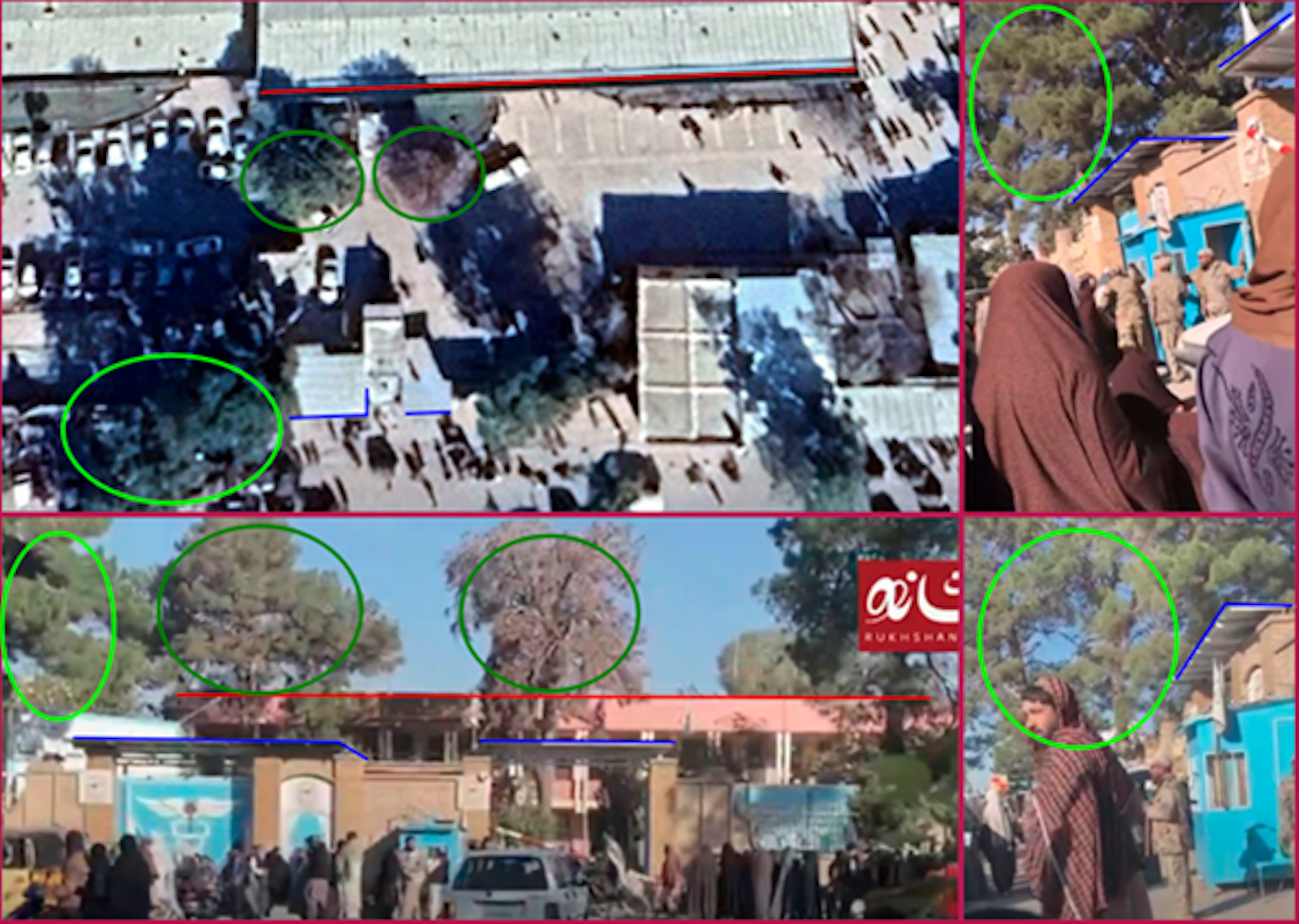
Despite his assurances, AW geolocated several videos shared on social media on 9 November 2025 to the main gate of Herat Regional Hospital, the largest hospital in western Afghanistan. The footage showed a large crowd of women, many accompanied by young children, attempting to enter the hospital as Taliban members in military uniform and ombudsmen from the Ministry for the Propagation of Virtue and the Prevention of Vice (MPVPV) prevented them from doing so, in some instances through the use of violence.