Since January 2024, pro-Russian Telegram channels (including some associated with Russian military units) and occupying authorities in Kherson Oblast have repeatedly declared a 60 km² “red zone” in Kherson and Antonivka. These channels state that any vehicle or critical civilian infrastructure found in this area represents a legitimate military target, posing an obvious risk to any civilian who finds themselves in the “red zone”. 

Since July 2024, CIR has collected and verified footage and images showing Russian drone attacks on likely civilians and civilian infrastructure in the city of Kherson. This interactive map shows all attacks on likely civilians, civilian infrastructure and emergency service workers recorded and verified by CIR that took place in this “red zone” since July 2024. As of December 2025, CIR has verified 317 such incidents. The data contained in this map only includes attacks verified by CIR. Reports of attacks in Kherson occur daily, with the UN estimating that 200 civilians have been killed so far, with a further 2000 injured. 

While CIR has verified a number of incidents in the “red zone” that have targeted likely military personnel, the majority of incidents have in fact targeted likely civilians. CIR hopes this map will increase public awareness of the ongoing toll of Russia”s full-scale invasion on Ukraine”s civilian population in Kherson.

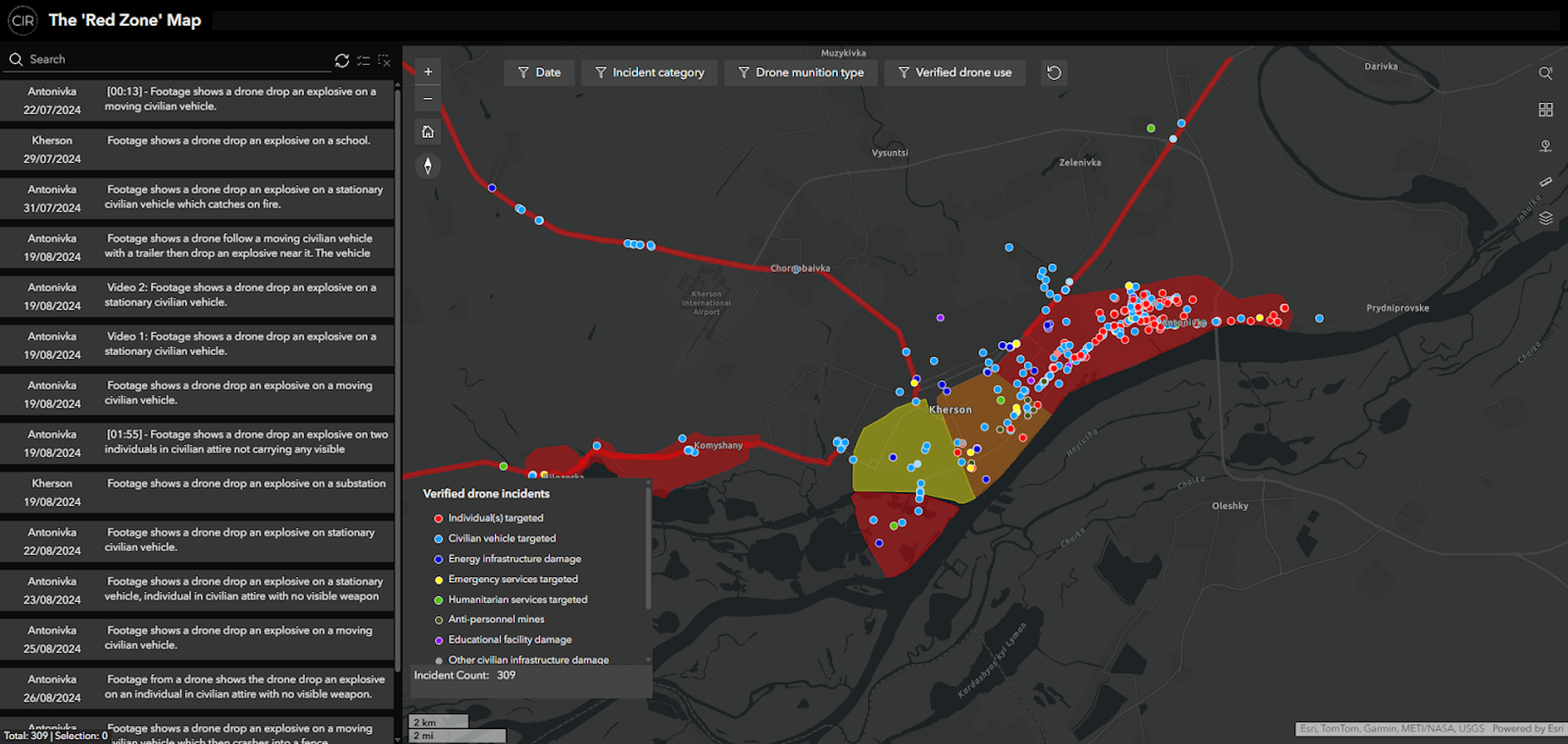
Sources: Telegram, available on the Red Zone Map

How to use the map

Map data can be filtered in a number of ways, you can:

  • Select start and end dates to define a specific time period
  • Select one or more incident categories
  • Select one or more drone munition types
  • Search for key words, such as place names, using the free text box.

These search functions can be applied together or on their own.

Each pin on the map represents a piece of verified data. You can continue your analysis of the data by:

  • clicking on a pin to display a preview box of the data and its characteristics, including a link to the original source of the data (see verification processes below for more details)
  • selecting the timeline option, which also features a timelapse function. 
  • selecting or deselecting layers corresponding to different districts and roads targeted by Russian drone attacks. 
  • increasing or decreasing the magnification of the map.
  • changing the map’s base imagery (satellite imagery can provide useful contextual information). 

Methodology

The map draws from a database of videos, photos and drone footage related to Russian drone attacks in Kherson.

Verifying likely civilian targets

Since Russian forces consistently claim that they only pursue military targets, CIR has attempted to verify the general identities of individuals struck by drones in circulated footage.

CIR classifies “individual(s) targeted” as individuals who appear to be wearing civilian clothing with no visible weapons, protective gear or other indicators of military status. This absence of military identifiers informs CIR”s assessment that such individuals are likely civilians. CIR acknowledges that visual evidence alone cannot entirely rule out the possibility of military affiliation.

CIR has found that Russian units conducting these attacks show little to no evidence of distinguishing between civilian and military targets prior to attacks. While the absence of such evidence does not in itself establish a violation, the available information raises concerns regarding compliance with the principle of distinction under Article 51 of the Geneva Conventions, and warrants further investigation.

Reducing traffic to harmful sites

This map draws from violent, graphic content posted by pro-Russian Telegram channels and collected, verified and archived by CIR. To reduce the risk of exposing users to these channels CIR has created a dedicated Telegram channel to host reuploaded versions of this content. This allows users to access evidence relevant to the map without being redirected to channels which promote violence or extremist narratives. This process also aims to avoid additional traffic to these channels and not amplify them or their ideology, whilst maintaining evidentiary integrity and transparency. 

In some cases, a link may be included to the original channel. In all cases, a verification date and incident code (e.g. TG001) have been assigned to each piece of media corresponding to the relevant data point on the map itself.

Please contact CIR if you would like to request other archived data not available on the map.

Verified vs claimed drone use

CIR classifies drone use as either “verified” or “claimed”. Drone use is considered “verified” when the available media includes on-board drone footage or visual evidence of drone debris following a strike. Drone use is classified as “claimed” when there is visual evidence consistent with a drone strike but no on-board drone footage or visual evidence of drone debris. This latter category is included in the map since visual evidence of damage may nevertheless indicate the use of a drone in an attack.

Definitions

Incident categories

Individual(s) targetedIndividuals who appear to be wearing civilian clothing with no visible weapons, protective gear or other indicators of military status. 
Civilian vehicle targetedVehicles placed in this category appear to show no markings, camouflage or other indicators of military status.
Energy infrastructure damageInfrastructure which generates, stores or transmits energy to Kherson’s civilian population. Sites might include substations or thermal power plants. 
Emergency services targetedTargeted individuals or vehicles of national emergency services like the State Emergency Service of Ukraine (DSNS).
Humanitarian services targeted Targeted individuals or vehicles of humanitarian or volunteer organisations, or those conducting humanitarian operations such as evacuations. 
Anti-personnel minesVisual evidence of anti-personnel PFM-1 ‘petal’ mines.
Educational facility damageDamaged facilities such as schools, nurseries and university buildings. 
Other civilian infrastructure damageOther infrastructure not specified as educational or energy.
Unidentifiable individual(s)Individuals who are not verifiably civilian (that is, when footage is too unclear to see evidence of military affiliation in the form of a  military uniform or weapon). 
Unidentifiable vehicleVehicles that are not verifiably civilian (that is, the footage is too unclear to see evidence of military affiliation such as markings, camouflage or other indicators of military status)

Drone munition type

Drone-droppedIncidents where there is visual evidence of a drone carrying then releasing explosive ordnance from a height onto its target.
First person viewIncidents where there is visual evidence of the use of a first person view (FPV) drone. This is a drone with an explosive fixed to its front,which is controlled by its operator through a live first person view feed. 
MinesIncidents where there is visual evidence of anti-personnel PFM-1 “petal” mines. CIR has identified both footage of Russian units strapping PFM-1 mines to drones and footage of them being dropped by drones. CIR therefore assesses any PFM-1 mine verified in Kherson, will have been highly likely dropped by a drone. This category also involves geolocated footage of the PFM-1 mines being dropped themselves. 

Violence levels 

In this map, each incident has been assigned a violence level to warn users of graphic material.

NoneMedia showing damage to infrastructure or a strike on a target featuring no explosion or visible evidence of human life.
ModerateMedia showing either explosions and/or strikes on individuals or evidence of the presence of human life (e.g. strikes on moving civilian vehicles). Audible or visible human distress may be visible. Evidence of injury or blood is not visible.
GraphicMedia where visual evidence of injury is visible and/or deceased individuals are blurred. Injury or blood may be visible.
SevereMedia showing strong visual evidence of injury and/or unblurred images of deceased or severely injured individuals. Blood visible.

Latest reports, direct to your inbox

Be the first to know when we release new reports - subscribe below for instant notifications.

Share Article