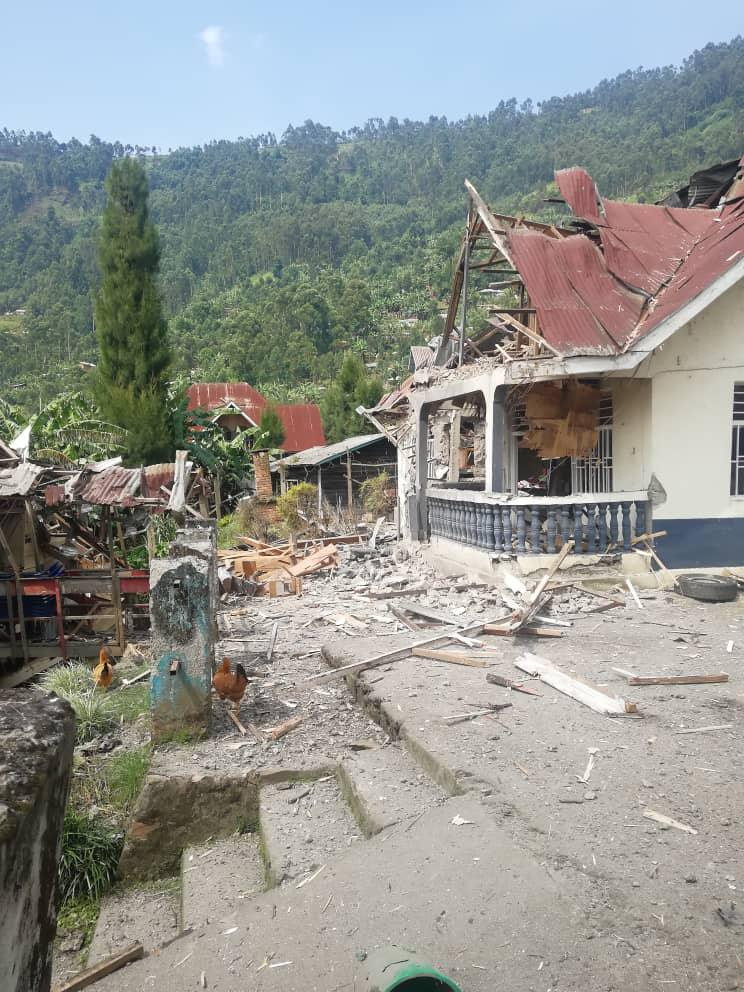
On 2 January 2026, an airstrike on central Masisi, eastern DRC, reportedly killed 22 and injured at least 40 others. The strike destroyed homes and also damaged the offices of War Child, an NGO serving children affected by conflict. M23, a Rwandan-backed Congolese paramilitary group, and the Congolese government – opposing sides in a conflict with causes stretching back at least 30 years – have since blamed each other for the attack.

The historical roots of the conflict

The ongoing conflict in the DRC has deep historical roots in Belgium’s brutal colonial exploitation and occupation of the country from 1908–60, followed by destabilising interventions by both Belgium and the United States in the years following independence. The more immediate origins of the ongoing conflict – now confined mostly to the Kivu region of eastern DRC – can be traced to the 1994 Rwandan genocide, in which an estimated 800,000 Tutsi people and Hutu moderates were killed. 

This displaced some 2 million people, many of whom fled across the border to eastern DRC and took shelter in camps controlled by the defeated remnants of the Rwandan armed forces responsible for the genocide. Demanding that the camps harbouring the génocidaires be dismantled, the Rwandan and Ugandan governments backed the then-emergent AFDL, a Congolese rebel group, to dismantle the refugee camps and install a friendly regime in Kinshasa that would secure their strategic, political and economic interests. The AFDL subsequently committed a slew of atrocities in the east – the 1996 Lemera hospital massacre being the most notorious – before taking Kinshasa in 1997.

A series of escalations characterised by a particularly brutal combination of killing and weaponised sexual violence has since splintered the DRC itself and many of its neighbours into a maelstrom of opposing alliances and claimed the lives of an estimated 6 million people. Dubbed ‘Africa’s World War’ due to the sheer number of nations implicated in the fighting, this bloody and protracted cycle of conflict has at every stage been compounded by the DRC’s rich natural resources, fiercely contested by successive governments and rebel militias and coveted by foreign powers and markets.
Today’s conflict

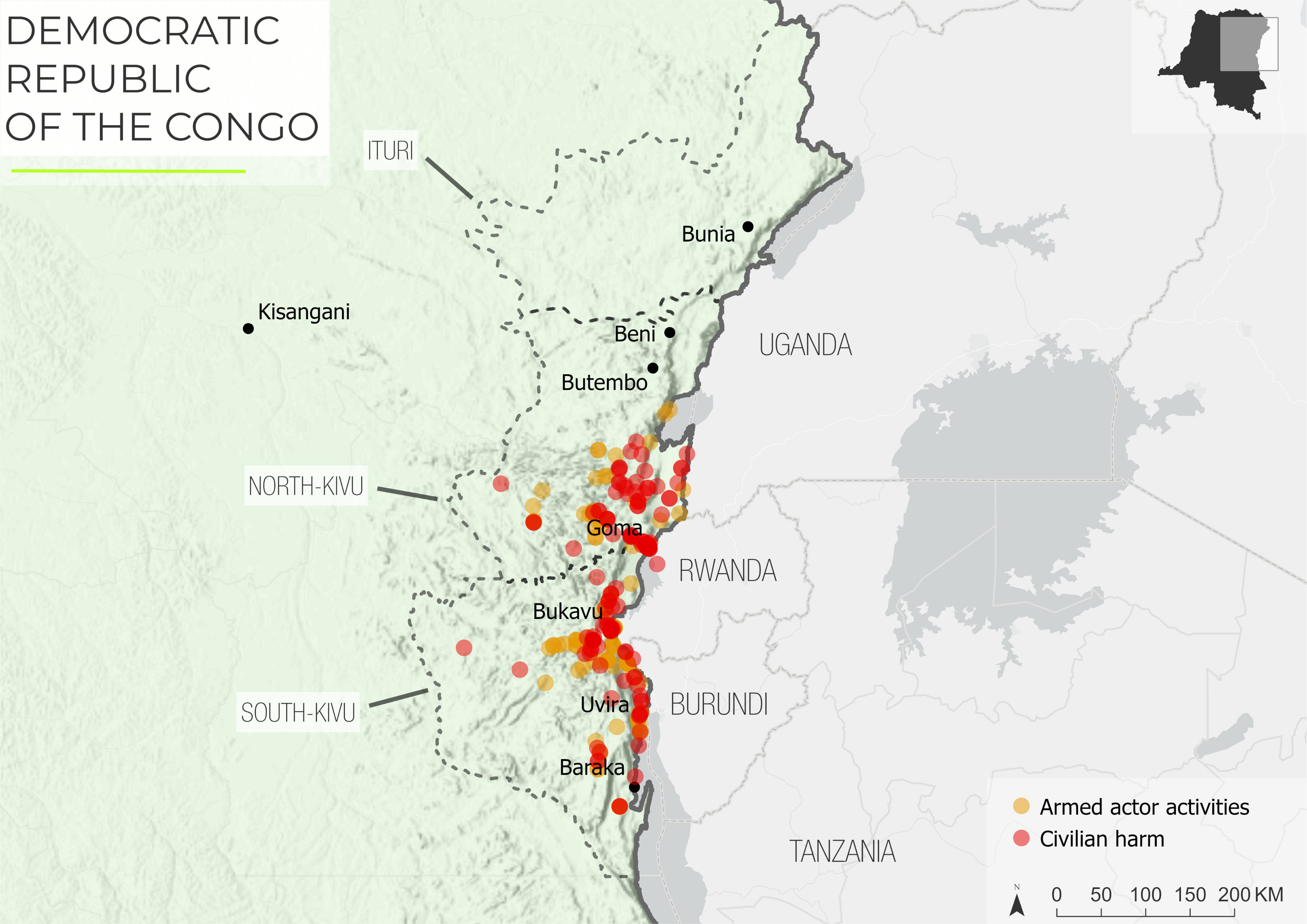
Operating along these ethnic, geopolitical and economic faultlines, the current round of fighting began when M23 – a paramilitary rebel group led by ethnic Tutsis – seized Goma in January 2025. Home to over a million and close to the border with Rwanda, Goma is an important node along trade routes emanating from the DRC’s rich mineral deposits. In February, M23 went on to capture Bukavu, a major city in South Kivu, but the group’s threats to target distant Kinshasa never materialised. CIR exclusively monitors the provinces of Ituri, North Kivu and South Kivu and, as this map of incidents logged by CIR shows, the majority of the fighting in these areas has taken place along the north-south axis of the DRC’s border with Uganda, Rwanda and Burundi.

Map showing CIR-logged incidents in the eastern DRC from February 2025–January 2026

Much like its previous iterations, the current conflict involves an extensive array of belligerents that can be difficult for outside observers to disentangle – from Rwandan-backed M23 rebels and Alliance-Fleuve Congo (the former’s political wing), the Rwandan Defence Force (RDF), the Twirwaneho and the newly formed Convention for the Popular Revolution (CRP) on one side, to the Congolese army (FARDC), the Burundian army, the explicitly Hutu Democratic Forces for the Liberation of Rwanda (FDLR) and the Wazalendo on the other, not to mention foreign mercenaries. The conflict has recently, and not for the first time, embroiled the DRC’s neighbours, particularly Burundi and Rwanda, especially following the 4 December 2025 Washington Accords, which sought to broker a peace deal between Rwanda and the DRC.

Blockades, military expansion and displacement in Kivu

Since February 2025, a team of CIR investigators have been closely monitoring the situation, documenting the conflict’s many shifting dynamics, from troop movements and civilian infrastructure damage to online responses to major escalations.

In November 2025, CIR observed increased military buildup in the Minembwe area of South Kivu. Following an announcement from Burundian officials that a blockade had been established to choke supply chains delivering food to M23, CIR analysed satellite imagery revealing what are highly likely new military bases along roads leading to Minembwe, likely constructed to enforce the blockade. The announcement implied that the army was treating anyone coming from closed routes as a collaborator and that free movement was being actively restricted. This raises concerns of possible violations of international law, which stipulates the right of civilian populations to aid and free movement in case of blockade. CIR subsequently geolocated a video shared on X showing locals protesting the blockade’s effect on access to vital supplies of food and medicine.

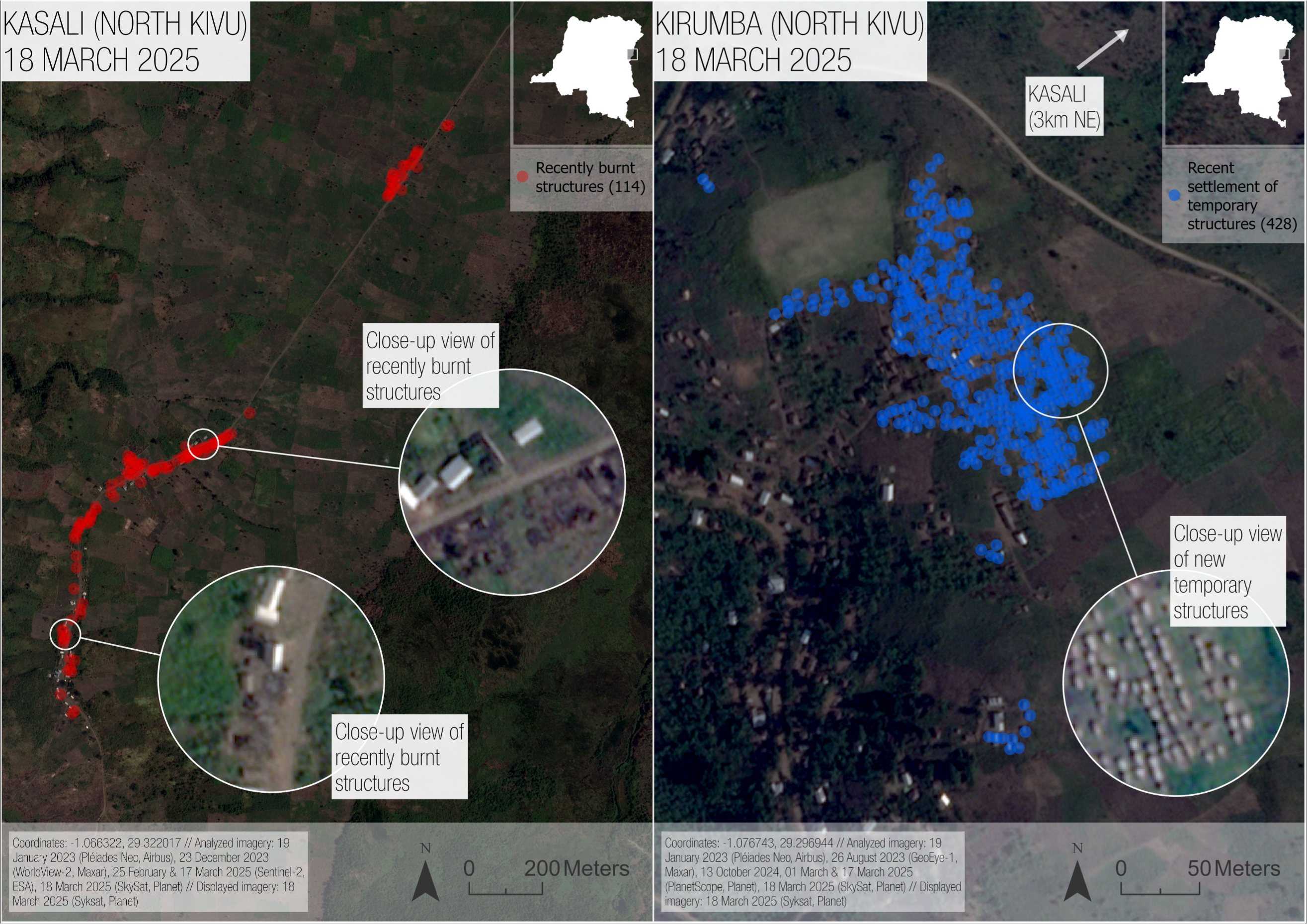
In March 2025, reports emerged online claiming that M23 had razed some 200 buildings in the village of Kasali, North Kivu, in an alleged move to punish local populations suspected of harbouring FARDC soldiers. While no civilian casualties were reported, satellite imagery analysis conducted by CIR revealed that at least 114 structures had recently been burnt to the ground. CIR then identified at least 428 temporary structures in nearby Kirumba, just 3 km from Kasali. Many of these structures appear to have been erected following the 7 March attack, indicating that a significant portion of Kasali’s resident population had highly likely been displaced from their homes.

[Left] Satellite imagery showing burnt structures in Kasali, 18 March 2025; [right] satellite imagery showing temporary structures erected in Kirumba, 18 March 2025 (Satellite imagery source: Images © 2025 Planet Labs Inc. All Rights Reserved. Reprinted by permission)

Online reactions to peace efforts

CIR has also conducted analyses of online activity around notable milestones in the conflict to gauge local and international responses to key events. On 4 December 2025, the same day locals protested the blockade in Minembwe, Rwandan and Congolese delegations met in Washington to sign a peace agreement slated to bring an end to the conflict. Despite the signing of the agreement, fighting continued apace as M23 advanced towards Uvira, the last major FARDC military supply hub in South Kivu, before taking the city on 9–10 December. 

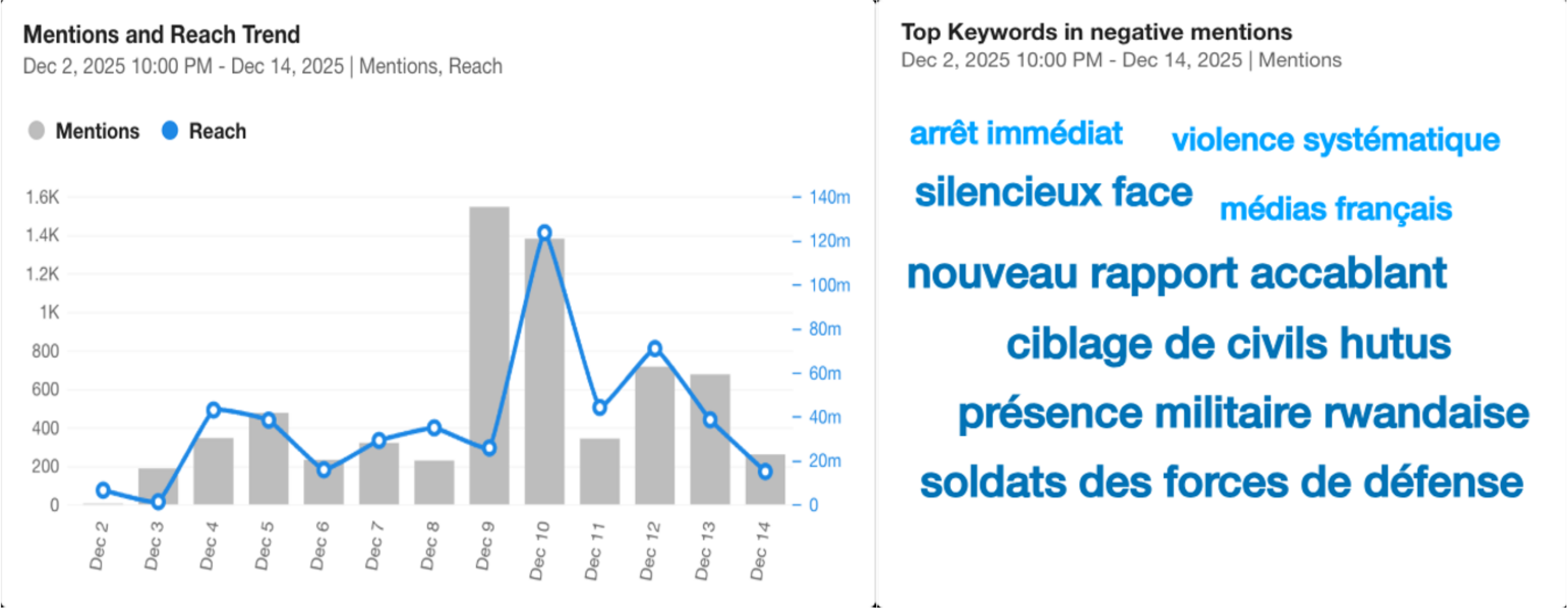
Between 2–14 December, CIR observed some 6,700 posts on X that explicitly criticised the agreement, with negative mentions reaching their peak in concurrence with the capture of Uvira on 9–10 December. The majority of negative reactions came from accounts registered within the DRC and indicate dissatisfaction with the inefficacy of the peace process and the resultant prolongation of hostilities. In a telling indication of the foreign intervention, ethnic tensions and routine killing that have come to characterise conflict in the DRC, among the top keywords in these posts were ‘Rwandan presence’, ‘targeting of Hutu civilians’ and ‘systematic violence’.

Online trend analysis on X conducted by CIR. [Left] total negative mentions posts and reach of negative mentions posts 2–14 December; [right] top keywords in negative mentions posts 2–14 December.

The challenges and opportunities of OSINT in a complex conflict

The typical challenges associated with remote investigation are amplified in the case of eastern DRC: reports that lack verifiable images or videos; a convoluted and constantly evolving online information sphere; and an opaque mixture of deliberately and unintentionally spread false claims (dis-/misinformation). ‘Online information is heavily manipulated’, says one CIR investigator, ‘all sides try to push their own narratives or hide damaging information’, making it difficult to assess the provenance of sources and verify emerging claims. 

Technical difficulties also abound; “satellite analysis is often made difficult by very frequent cloud cover”, says another CIR investigator, a situation that is compounded by low interest from commercial imagery providers in a typically underreported conflict. Add to all of this the complex interplay of competing alliances, ethnic tensions, geopolitical sabre-rattling and historical precursors sketched above and the challenges to meaningful analysis becomes even starker.

Despite this, OSINT can be a valuable tool for understanding a prolonged and miserable cycle of violence that in the DRC alone has produced 7 million internally displaced persons, subjected 25 million to food insecurity and left 4.5 million children suffering from acute malnutrition. “The fighting in eastern DRC is fast-moving and politically charged”, writes Benjamin Strick, Director of Investigations at CIR, “every side has an incentive to shape the story”. But through rigorous OSINT analysis, investigators can “track events independently and document civilian harm even when access is restricted” to illuminate patterns of violence and inform responses that aim to protect civilians and support accountability.

Latest reports, direct to your inbox

Be the first to know when we release new reports - subscribe below for instant notifications.

Share Article