Ranging from small, localised militias to larger, state-backed forces, armed groups in eastern DRC possess diverse motivations and cannot be neatly divided into opposing camps. Local land disputes, control of natural resources, ethnic tensions, religious fundamentalism and foreign interests are just some of the overlapping factors that drive this fragmentation. This dense network of competing alliances can be difficult for outside observers to disentangle, so we spoke to our expert investigators Anne, Chloe and Arthur* for insights into the dynamics behind such a complicated picture and what they mean for open-source investigations.
Why are there so many armed groups in eastern DRC?
6 min read
CIR

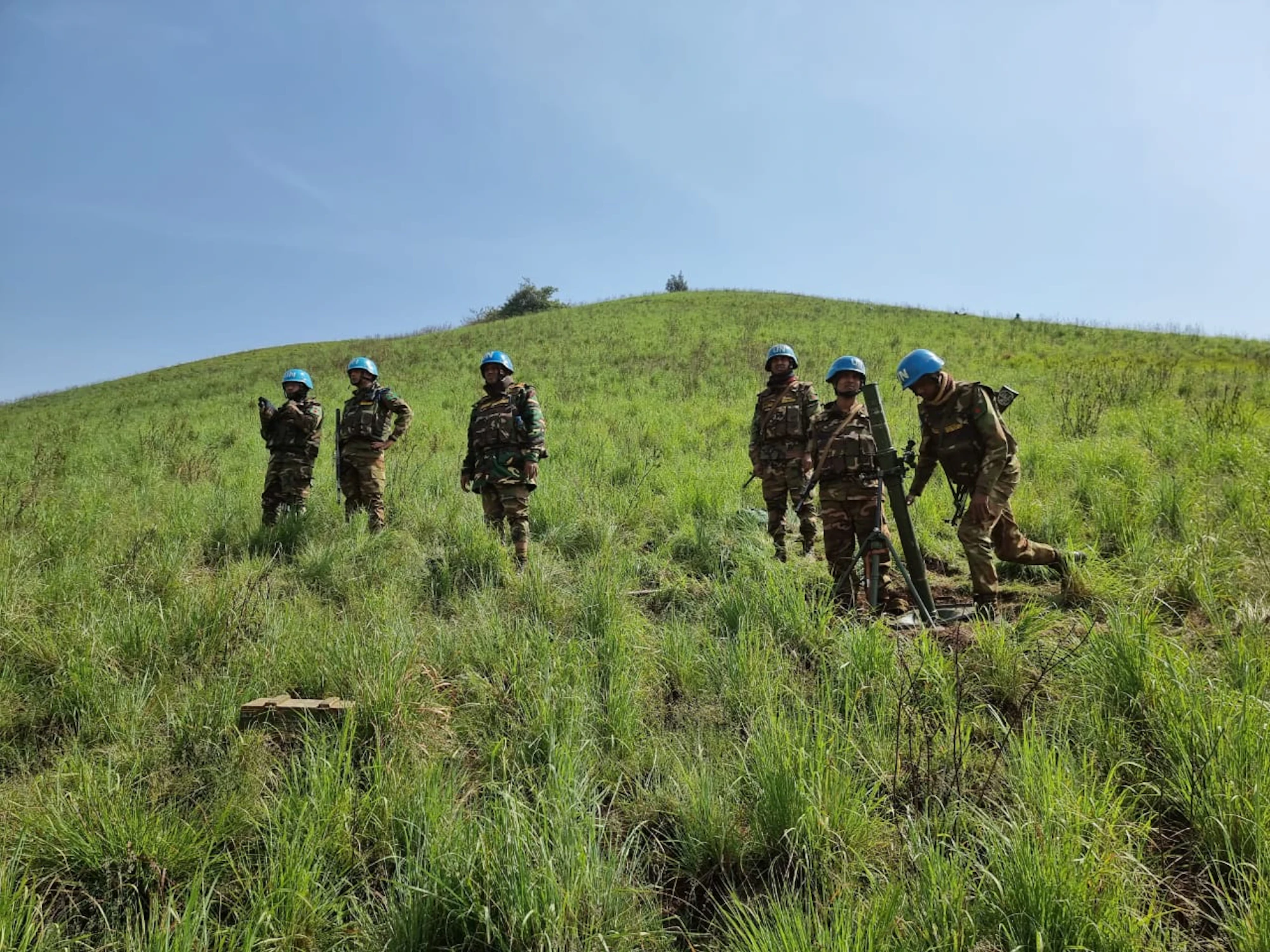
MONUSCO peacekeepers in Ituri, eastern DRC, 2022 (MONUSCO Photos via Wikimedia Commons, CC BY-SA 2.0)
On 28 April, at least 69 people were reportedly killed following an attack in Ituri Province, eastern DRC, carried out by the Cooperative for the Development of the Congo (CODECO), a loose conglomeration of militias affiliated with the Lendu ethnic group. Two days later, on 30 April, MONUSCO (the UN’s peacekeeping force in eastern DRC) announced it had rescued 200 people from an assault by the Convention for the Popular Revolution (CRP) on positions held by the Congolese army (FARDC). CODECO and CRP are just two among an estimated 120 armed groups currently operating in a conflict that has long been characterised by an extensive array of belligerents, but why are there so many and how are they to be understood in the context of the ongoing conflict?
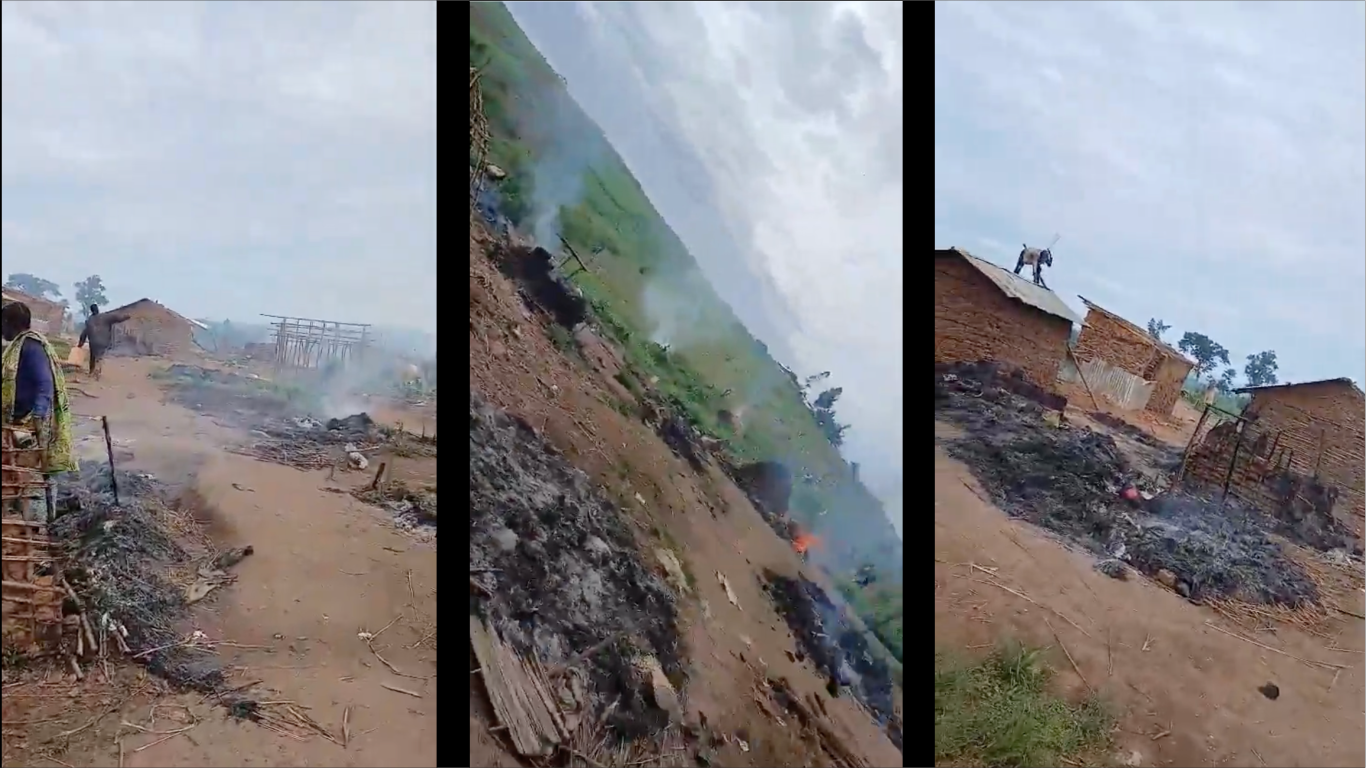
Stills from UGC allegedly showing the aftermath of the 28 April CODECO attack in Ituri (source: HeritierBarak/X)
What drives the fragmented picture of armed actors we see in eastern DRC?
“Geography plays a huge role”, says CIR investigator Arthur. Eastern DRC is a vast expanse of territory (almost 258,000 km2) in a country itself roughly the size of Western Europe. Its thick forests and extensive mountainous regions ‘make it extremely difficult for any central government to project power there effectively’ and, as a result, the power vacuum created by this topography has been filled by armed groups. Historically, this is perhaps best epitomised by the Alliance of Democratic Forces for the Liberation of Congo (AFDL), a loose coalition of Ugandan- and Rwandan-backed rebels whose successful 1996 campaign to install a new regime in Kinshasa began in eastern DRC along the border with Rwanda. In addition to this limited reach, ‘the Congolese state never had full monopoly on the legitimate use of force’, says CIR investigator Chloe, which has driven the armed proliferation of groups working to secure their own competing economic, ethnic, religious and territorial interests. Below is a map showing all incidents logged by CIR since October 2025.
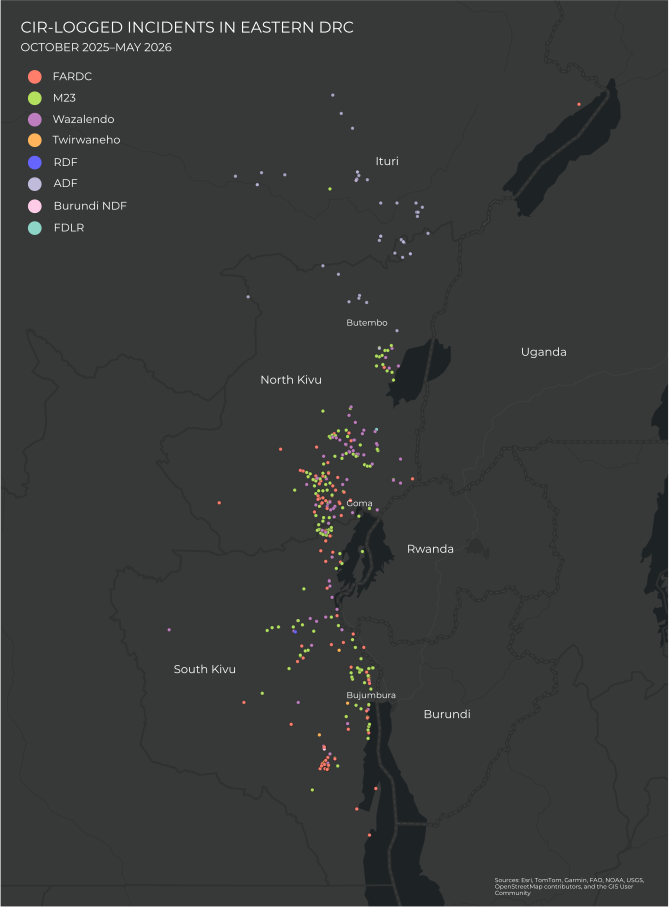
Map showing incidents in eastern DRC logged by CIR since October 2025. Actors responsible have been designated in accordance with claims and reports.
This security vacuum has created something of a haven for armed groups that originated from elsewhere. ‘Take the ADF’ (Allied Democratic Forces), says Arthur, an originally Ugandan rebel group that ‘found refuge in eastern DRC where they could easily organize and operate’, before eventually affiliating with ISCAP, the central African chapter of the Islamic State. In early 2025, as the already stretched Congolese armed forces (FARDC) were redeployed to counter M23, ADF capitalised on the reduced presence of state forces to expand their operations. States themselves also rely on armed groups to secure their own agendas: M23, the rebel group whose seizure of Goma in January 2025 sparked the ongoing round of fighting in the region, is reportedly backed by Rwanda, while the Congolese government reportedly backs the Democratic Forces for the Liberation of Rwanda (FDLR), a Rwandan rebel group, to fight M23.
Tensions between the dozens of ethnic groups in the region are also a major factor driving both violence and the proliferation of armed militias. The legacy of the Belgian colonial administration’s divide and rule approach, which strategically pitted ethnic groups against one another, has been exacerbated by post-colonial administrative land divisions that do not always reflect the ‘ambiguous and highly heterogeneous cultural and political landscape’. The violence seen in Ituri in late April encapsulates these dynamics: CODECO and the recently formed CRP are, respectively, aligned with the local Lendu and Hema populations, who have long been embroiled in disputes that can be traced back to Belgium’s colonial occupation. These attacks likely represent tit-for-tat escalations between two armed groups opposed along ethnic lines.
The DRC’s vast mineral wealth is another important factor, says Arthur, as ‘controlling mining areas means controlling access to significant wealth and influence’. As is the ‘lack of sustainable peacekeeping measures’, according to Chloe. Without sufficient disarmament, demobilisation and reintegration programmes, members of militias and paramilitary groups are more likely to splinter and regroup.
How does this fragmented picture affect open-source investigations?
At face value, the sheer number of groups and the complicated web of interlocking alliances pose obvious and significant challenges to remote investigations simply because these facts are so deeply rooted in unique regional dynamics that are difficult to unpick from a distance. Arthur says
‘This also makes it difficult to know who is really making decisions around specific conflict events. While there is strong evidence for Rwanda’s direct support of M23, for example, pinning down the exact level of control, or understanding the chain of command for direct orders is often impossible with open sources’.
For Chloe, the challenge lies in smaller armed groups like CODECO and CRP, who tend to lack the uniforms or distinct clothing that allow investigators to determine who might have carried out an attack. Without these markers, it can be difficult to ‘distinguish a militia fighter from an armed civilian or mercenary’, for example, and ultimately build a robust, verified picture of responsibility. It is often, but by no means exclusively, smaller groups and militias – like CODECO, CRP, ADF, and the Wazalendo – that carry out deadly attacks on civilians. According to Chloe, these groups are more ‘immune to international and regional pressure since they are either only loosely affiliated to more official actors or completely independent’.
Direct evidence of attacks carried out by armed groups is rare, according to CIR investigator Anne. This means investigators have to rely on reports, claims and aftermath footage as a basis for reconstructing events. Anne says
‘When it comes to gauging online responses to major conflict milestones the presence of multiple armed groups in the DRC creates a highly fragmented online space. This polarisation means that online responses vary greatly, while rapidly spreading competing claims make it difficult to develop a full understanding of conflict dynamics and which actors are responsible’.
Accepting these challenges and finding ways around them is a core requirement of OSINT work on eastern DRC. As Arthur says, ‘there are simply too many armed groups to track 100%’. This limitation, however, does not mean that we cannot get a sense of what is happening and who is responsible. While the activities of smaller groups are more difficult to capture, OSINT can still be used to generate a broad picture of the patchwork of competing alliances in the region and enhance our understanding of a complex and constantly evolving conflict.
The complicated causes of a complicated picture
In eastern DRC, the factors driving the presence of so many armed groups are perhaps as extensive in number as the groups themselves. Pre-existing ethnic tensions, limited state reach, foreign interests and the abundant presence of valuable minerals all combine to drive the proliferation of armed actors. While, simultaneously, the insecurity created by multiple actors vying for varying degrees of local and territorial control establishes the very conditions under which more armed groups are likely to emerge and enter the cycles of violence long witnessed in the region. This dynamic was recognised by the 2025 Washington Accords, which view the demobilisation and reintegration of armed groups and non-state actors as central to securing a lasting peace. As tensions and fighting have continued into 2026, it remains to be seen whether the peace process will achieve its aims.
*investigators have been anonymised to protect their privacy