Definitions
Primary and secondary categories
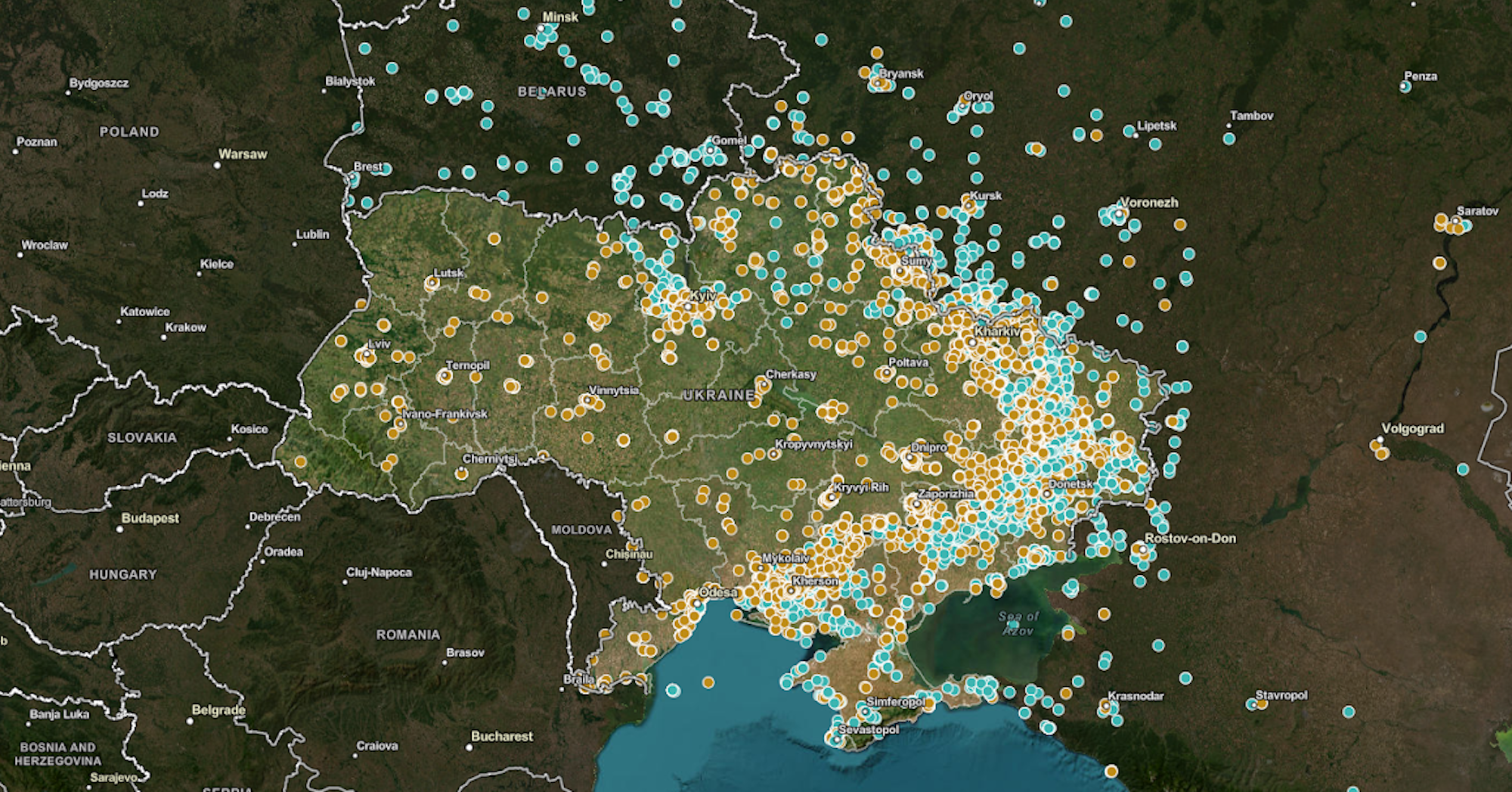
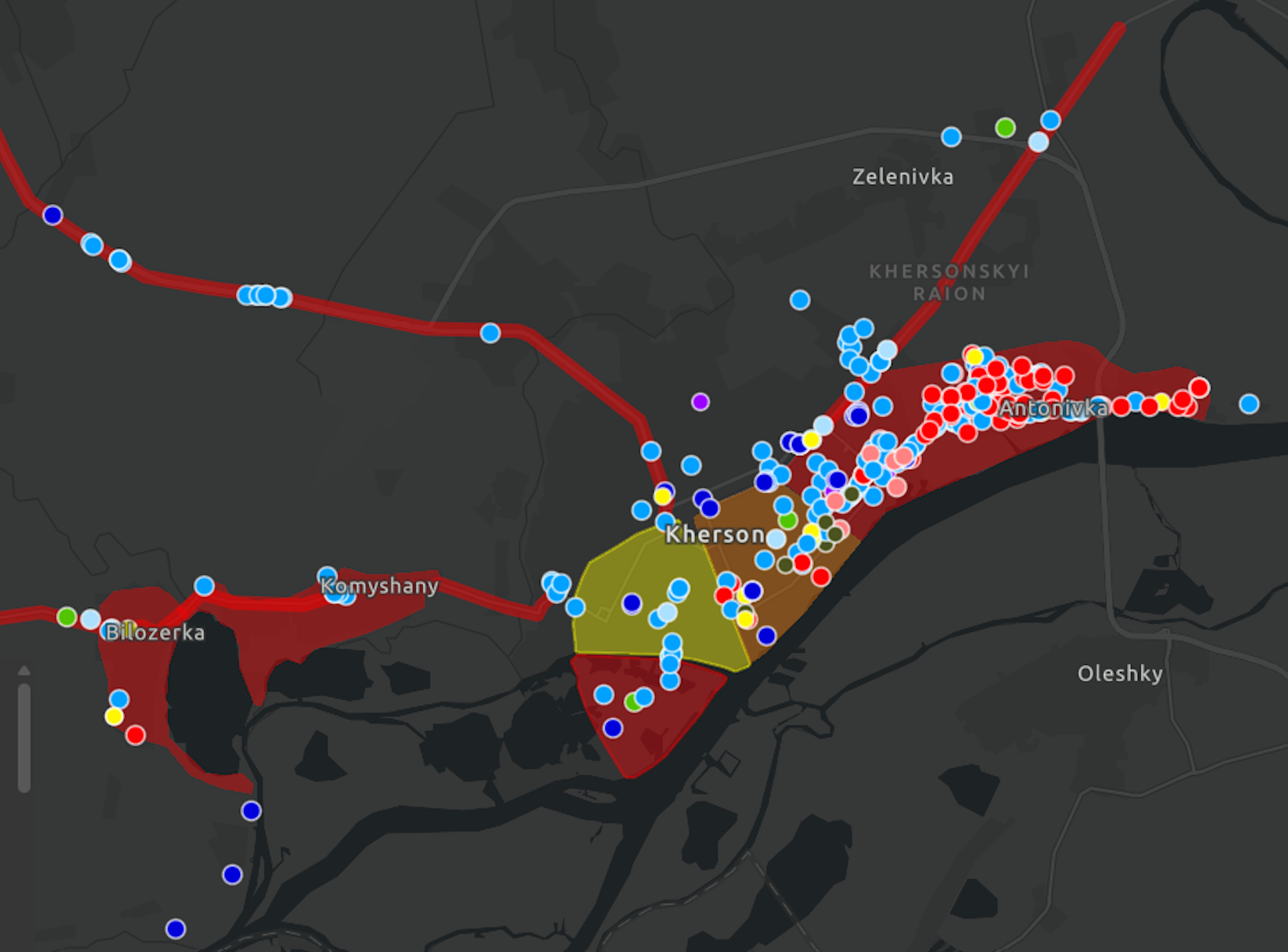
Categories are split into primary and secondary types. Although both draw from the same list (see below), investigators assign one primary category to each datapoint to support consistent classification and mapping. Datapoints may also include multiple secondary categories, which add further detail and enable users to filter the dataset more precisely:
| Bombing or Explosion | Bombing or explosion seen in footage |
| Civilian Casualty | Dead or injured civilians without uniform |
| Civilian Infrastructure Damage | Signs of damage to civilian buildings or other types of civilian infrastructure |
| Environmental Harm | Signs of environmental harm and/or impact |
| Detention or Arrest | One or more individuals being detained or arrested |
| Ground Battle | On-the-ground action between Ukrainian forces and the Russian military or its allies |
| Mass grave or Burial | Indications of graves or burials |
| Military Infrastructure Damage | Signs of damage to military buildings or other types of military infrastructure |
| Munitions | Visible munitions or munition debris |
| Russian Military Presence | Presence of Russian military vehicles, assets and/or troops |
| Russian Military Losses | Signs of damage to Russian military vehicles, persons and/or assets |
| Russian allies movements or losses | Signs of damage to military vehicles, persons and/or assets affiliated with Russian allies, such as Belarus or Chechnya |
| Russian Firing Positions | Signs of where Russian military assets have fired from or are seen firing from |
| Wagner | Incidents involving the persons or movement of Wagner PMC forces |
| Ukrainian Military losses | Signs of damage to Ukrainian military vehicles, persons and/or assets |
| Protest | Signs of pro-Russian or pro-Ukrainian protests in Ukraine, the temporarily occupied territories, or the wider region |
| Propaganda | Signs of pro-Russian propaganda in Ukraine, the temporarily occupied territories, or the wider region |
| Other | Where the above definitions do not fit |
Sector affected
Sector affected provides the user with more detail on their chosen datapoint, specifying the type of civilian infrastructure damage that has been damaged or otherwise impacted facilities, infrastructure or resources. CIR has updated these tags, allowing users to filter for trends such as Russian attacks on hotels, energy infrastructure and transport infrastructure.
| Agriculture and food supply | Buildings, factories, large markets, warehouses or fields relating to the supply of food for civilians |
| Bridge and crossing infrastructure | Infrastructure such as road and rail bridges |
| Civilian property | Residential buildings, apartments and houses |
| Commercial facilities | Shops, banks and other commercial buildings |
| Commercial food establishments | Cafes and restaurants |
| Cultural | Cultural sites of importance, such as heritage sites, stadiums, theatres and houses of culture |
| Educational facilities | Educational facilities such as pre-schools, schools and university buildings. |
| Energy infrastructure | Infrastructure such as substations, thermal power plants, hydro electric power, petrol stations and gas storage |
| Forestry | Combat or military assets in areas and/or damage to the ecosystem resulting in environmental concerns |
| Government buildings | Buildings and offices owned by or contributing to the effectiveness of the Ukrainian government |
| Hotels and accommodation | Hotels and other commercial accommodation |
| Humanitarian aid resources | Damage to sites, vehicles or injury to personnel providing humanitarian assistance |
| Industrial | Buildings or warehouses relating to industrial activity such as plants and mines |
| Infrastructure | Critical civilian infrastructure such as roads, bridges, energy, and transport facilities |
| Medical and health facilities | Medical and emergency service facilities such as hospitals, pharmacies and fire stations |
| Military facilities and assets | Infrastructure, vehicles or equipment relating to Ukrainian or Russian and its allies militaries |
| Religious buildings | Religious buildings such as churches, synagogues and mosques |
| Sanitation infrastructure | Infrastructure such as water pumping sites and treatment plants |
| Transport infrastructure | Infrastructure such as rail way or highways |
| Other | Where the above categories do not fit (note: damage to civilian vehicles are often included in this category) |
Disclaimer: The map and database include only information that CIR’s Eyes on Russia project has been able to collect and verify; it is not an exhaustive collection of all events or related details. All data points are assigned a violence level from 1 (non-graphic) to 5 (highly graphic). CIR does not publish information that may put individuals at risk, and may delay publication to protect civilian safety. CIR reports only on verified data and are not responsible for claims circulated on social media. While some information is crowdsourced, all entries undergo a rigorous, multi-stage review by senior investigators. Map pins link to verified videos, photos, or satellite imagery that have been geolocated and, where possible, time-verified. If you believe any data is inaccurate, please contact [email protected].