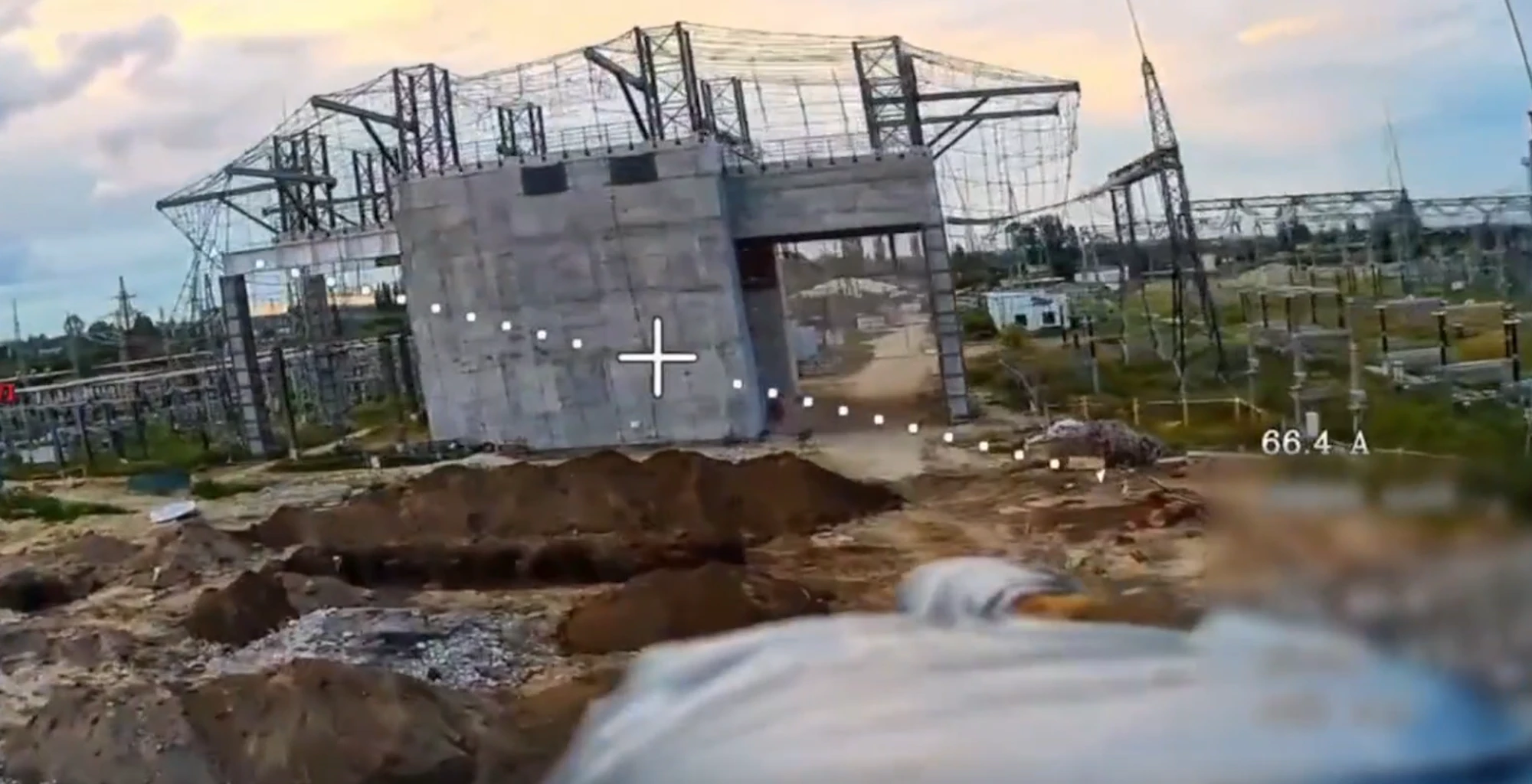
CIR’s Eyes on Russia project has been tracking Russia’s strikes on Ukraine’s energy grid for years. We spoke to investigator Joshua Scriven about how Russia chooses its targets, why winter is the critical period, and what open-source data reveals about a campaign aimed at civilian life.
Data collected by CIR’s Eyes On Russia project recently featured in a Reuters article on Russia’s use of small, unjammable drones to conduct precision strikes on electrical substations in Ukraine’s Sumy Oblast. In May 2026, the project contributed data and analysis for another Reuters article on how Russia’s targeting of small-scale electrical substations causes widespread disruption to Ukraine’s power grid. Back in 2023, the project published ‘Weaponising Winter’, a report into how Russia strategically times its strikes on energy infrastructure to maximise their impact on civilian life.
Following on from these pieces, we spoke to our primary investigator for energy infrastructure work, Joshua Scriven, uncovering expert insight into this key battleground in Russia’s full-scale invasion of Ukraine.
What are the calculations Russia is making when deciding which energy facilities to strike and when?
“The what and the when are directly related. It is not a question of striking any and all energy infrastructure but focusing on those facilities which, if damaged, can lead to cascading effects that can cause blackouts across entire regions or the entire country. This includes substations connected to nuclear power plants. While the plants themselves cannot be destroyed without risking a nuclear catastrophe, striking the substations through which nuclear power is supplied achieves the same outcome as cutting the plant off from the grid. Like cutting a tree’s branches and nailing the stumps instead of cutting the trunk itself – either way, the tree dies.
The aim here is clear: disrupt everyday life and target the morale of Ukrainian society to the point that it causes large-scale collapse in economic activity and extreme physical hardship, which diverts governmental resources away from primarily focusing on the conduct of the war and onto political and humanitarian crisis management.
As for when, critical facilities are struck mainly throughout winter because a lack of electricity and heating compounds the pressure felt by civilians and risks creating a humanitarian catastrophe. In the winter of 2025–2026, the energy and heating situation in Kyiv City was so dire that Mayor Vitali Klitschko urged those able to leave the city to do so. At one point in February, Mayor Klitschko reported that 2,600 high rise apartment buildings were without heating. To give a sense of scale, the International Federation of the Red Cross reported in January that 800 residential buildings were without heating, affecting 200,000 people.”
How does the level of damage to Ukraine’s energy infrastructure, estimated at $25 bn, compare to the resources Russia devotes to targeting it?
“Russia does not apply an economic cost/benefit analysis to its strike packages. Those employed against energy infrastructure are no more or less costly than those fired at other targets in Ukraine on any given day.
On a daily basis, Russia fires hundreds of one-way-attack (OWA) drones and up to several dozen missiles into Ukraine. Since around late 2024, this has followed a pattern of weekly ‘peaks’, where once or twice every one to two weeks a larger than average number of drones and missiles are fired in a single 24 hour period.
That Russia has been able to maintain these strike volumes all this time proves that, as of now, their financial cost has not been a limiting factor, even in spite of Ukrainian long-range strikes on the oil and gas infrastructure that fuels Russia’s war machine. So it appears that Russia has calculated that the cost of its campaign against Ukraine’s energy infrastructure does not outweigh the strategic benefits.
That being said, the fibre optic FPV drones Russia recently employed against transmission autotransformers in Sumy Oblast are miniscule in cost compared to the autotransformers they struck – roughly $2000 compared to $3,500,000. However, this did not look like a cost saving measure, but rather a way of exploiting gaps in the physical protective structures constructed around the autotransformers, that protect against Russian OWA drones and missiles.”
What kinds of challenges have you encountered in your data collection?
“The biggest problem is the timing of the strikes. They occur mostly in winter when satellite imagery coverage is at its poorest. This is the main method by which we verify damage to energy infrastructure, so not being able to use it when it is most needed is particularly challenging.
Given that Ukraine’s energy workers are now so adept at repairing damage, it is possible that damage to a substation struck in November is not visible in satellite coverage until February. By this point repairs have already been completed, and it appears on satellite as though there was no damage at all, which creates chronological gaps in our data that inhibit our ability to see a full picture of strike patterns over time.”
What makes reporting on these attacks so difficult?
“Their systematic nature. The pace of Russian strikes on Ukraine means that after every large-scale strike those from previous weeks are quickly forgotten. This makes it difficult to see the big picture, unless you are consistently collecting and analysing data on it all year round.
In addition, 750 kV transmission substations – some of the most important infrastructure – are located closer to small towns than regional capitals, so it’s easy to underestimate their significance. For example, I don’t recall ever hearing the town of Nalyvaikivka mentioned outside of Ukrainian media, but its 750 kV substation is on the main route of transmission of nuclear energy from the Rivne and Khmelnytskyi nuclear power plants to Kyiv Oblast. So counterintuitive though it may seem, a small black spot on blurry satellite imagery of that substation can be equally as consequential for Kyiv’s access to energy as several missile strikes on one of its thermal power plants.”