No safe ground: Displacement orders in Gaza

4 min read

CIR

CIR 's photo

Share Article

A two-part CIR investigation examines the use of displacement orders in Gaza between January and July 2025. It assesses what those orders meant in practice for civilians directed into shrinking safe zones, cut off from hospitals and water infrastructure, and prevented from returning to areas absorbed into an expanding military buffer zone.


In the first half of 2025, the Israel Defence Forces (IDF) issued 74 displacement orders across the Gaza Strip, directing civilians away from the vast majority of the territory. A two-part CIR investigation examines what those orders meant in practice: the conditions in designated safe areas, the military activity that followed, and whether civilians were ever able to return to the areas they were ordered to leave. 

The investigation covers the period from January to July 2025, drawing on open-source research, satellite imagery, geolocation analysis, and the verification of 220 incidents across Gaza. It analyses the language and frequency of displacement orders, military activity in both evacuated and designated safe areas, conditions in relocation zones, access to hospitals and critical infrastructure, and indicators that displacement may not be temporary. Together, the two reports indicate a likely pattern of widespread, systematic displacement.
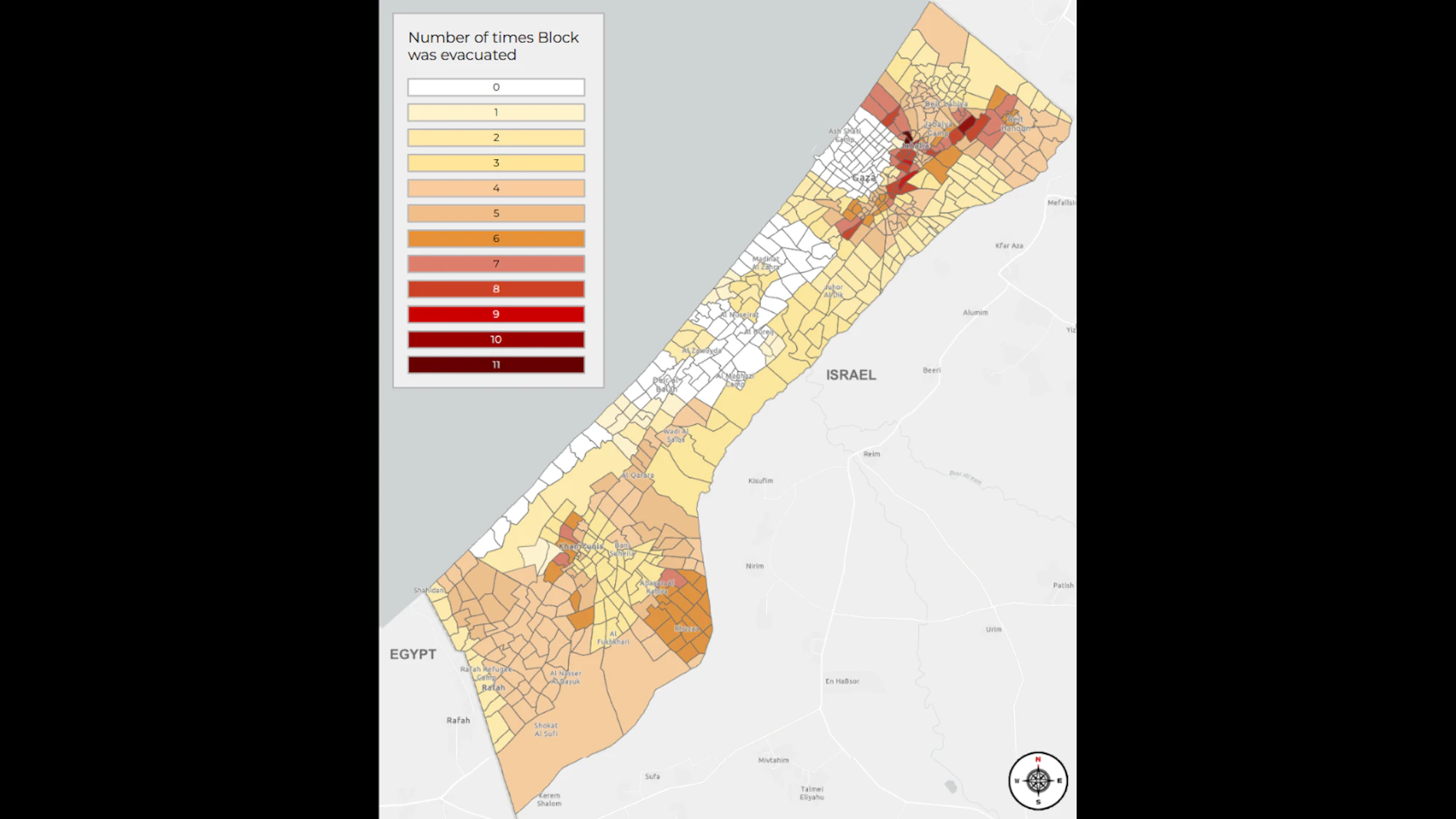
A map of the 623 Blocks in Gaza, showing the number of times each Block was evacuated between 1 January and 31 July 2025.

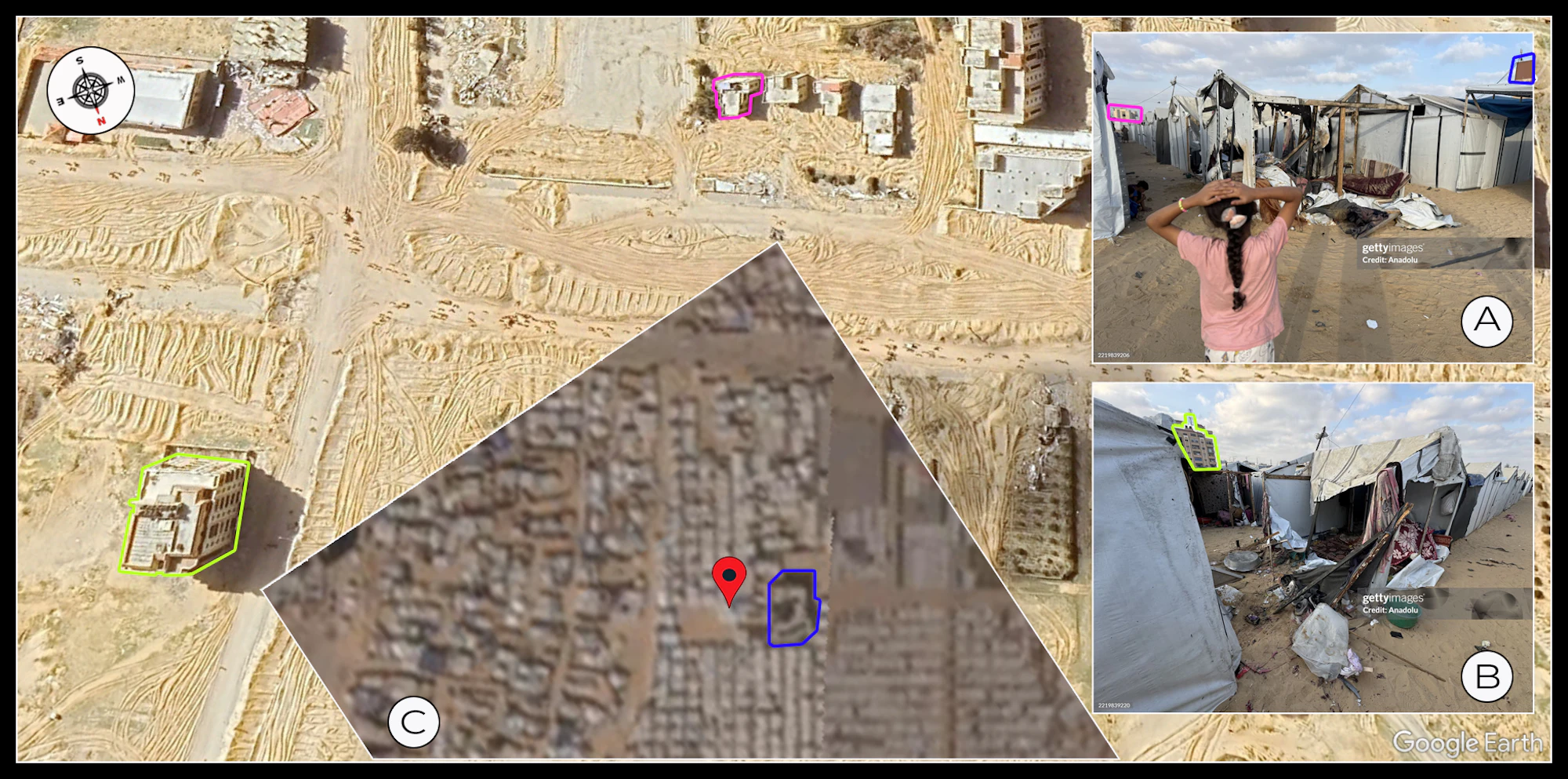
The designated safe destination for the majority of those orders was al-Mawasi, a coastal strip in the south that the IDF repeatedly described as “the safer zone.” Over half of all evacuation orders directed civilians there. Yet CIR verified 44 incidents within al-Mawasi’s boundaries during the investigation period alone, including munition strikes on IDP camps, drone attacks on tent settlements, and casualties among families who had already been displaced multiple times. On 17 June 2025, the IDF issued an evacuation order directing yet more civilians to al-Mawasi at 22:44 local time; CIR’s chronolocation analysis established that a strike on an IDP camp within the zone had occurred earlier that same morning.

CIR’s geolocation of IPIN3175, showing what appears to be a damaged tent in western Khan Younis at coordinates 31.3554, 34.2830. Source: Google Earth Pro, 2025 Airbus, 03/03/2024; PlanetLabs SkySat Imagery captured on 20/06/2025; A: IP13188; B: IP14246.

A shrinking zone

Between January and July 2025, al-Mawasi contracted from approximately 73km² to 24km², even as the number of displaced people arriving there grew. By July, just 17 of Gaza’s 394 water wells, 4% of the total, were accessible within its boundaries. A July 2025 evacuation order covered one of the largest remaining desalination plants in Gaza. UN OCHA warned that approximately 30,000 displaced people were living in the affected area and so any damage to water infrastructure there would have life-threatening consequences.

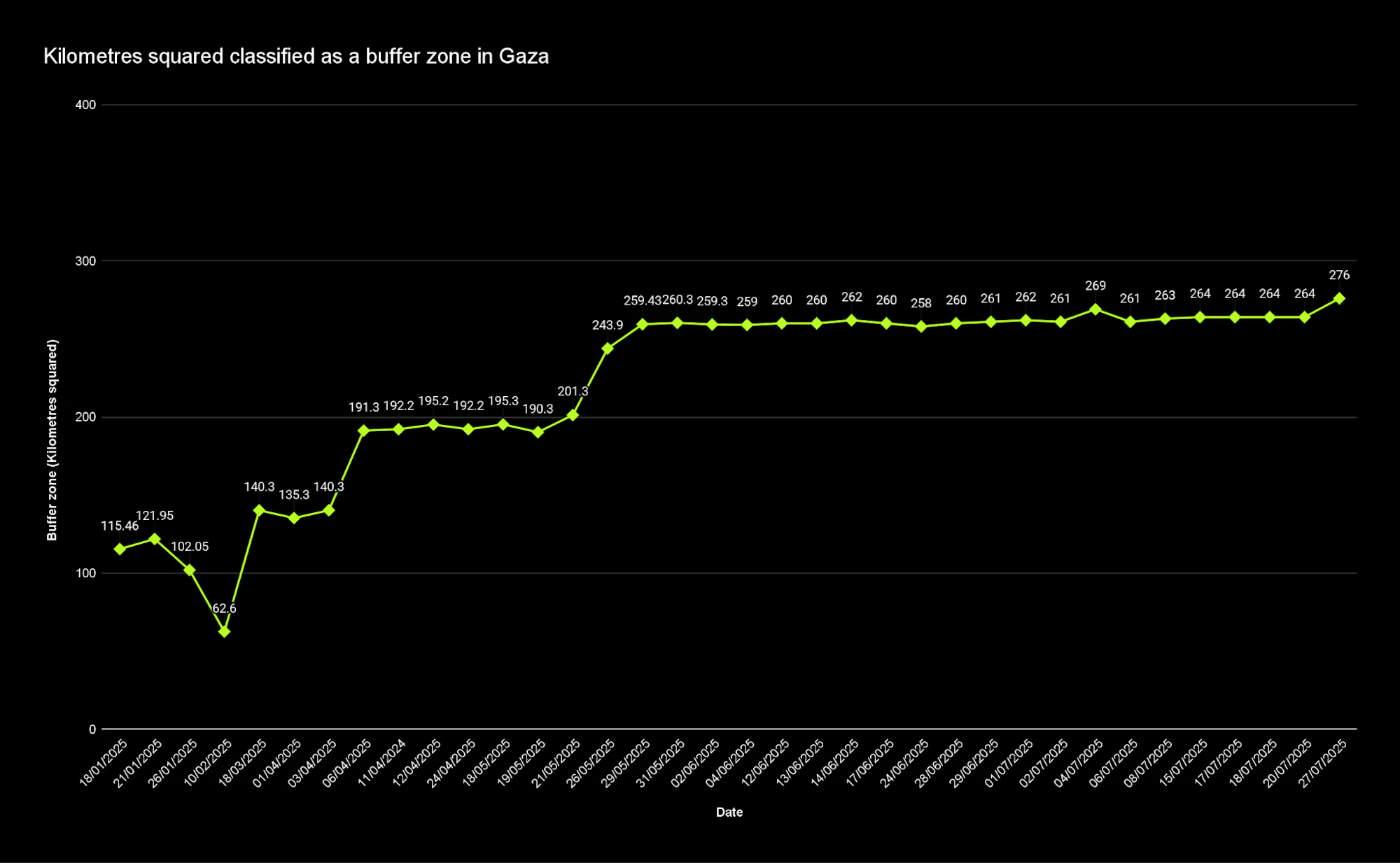
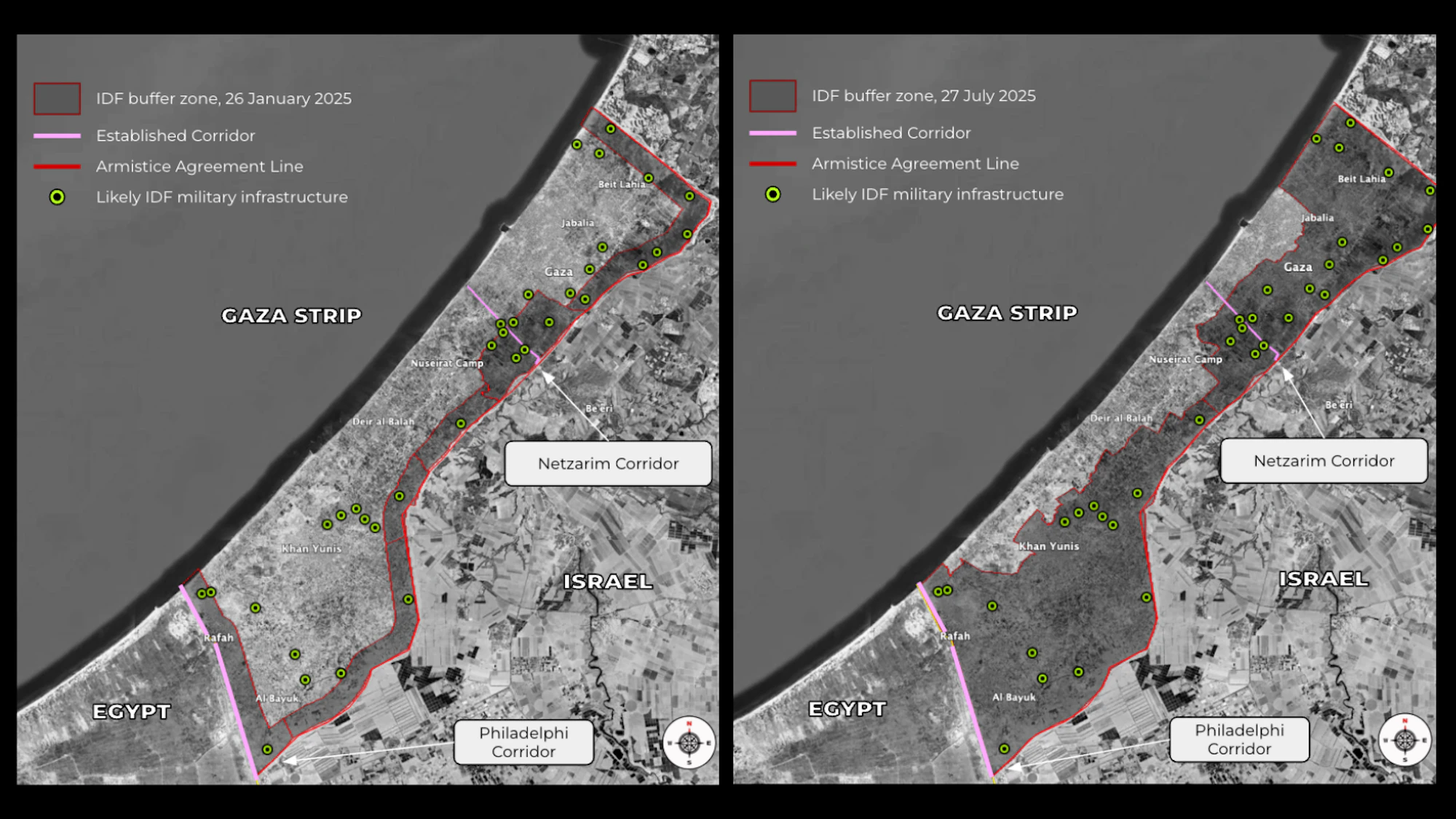
Meanwhile, the IDF-designated buffer zone, the area where civilian presence is prohibited, expanded continuously throughout the period, reaching approximately 76% of Gaza’s land area by late July. At least 88% of areas placed under evacuation orders were subsequently absorbed into it.

Area of the IDF’s buffer zone measured in km2 during the investigation period from January 2025 to July.

CIR’s satellite imagery identified 35 likely IDF military sites within the buffer zone, including positions constructed within former residential areas, some distance from the border fence. In two neighbourhoods surveyed in detail, one in Jabalia and one in Khan Younis, at least 70% of structures had been destroyed, with the majority of that damage occurring after the areas were added to the buffer zone.

Map of likely IDF military infrastructure in Gaza, based on Planet Labs Skysat satellite imagery from June, July and August 2025. Source: Google Earth Pro, CNES / Airbus, Airbus, Maxar Technologies, 23/12/2024.

Unclear instructions 

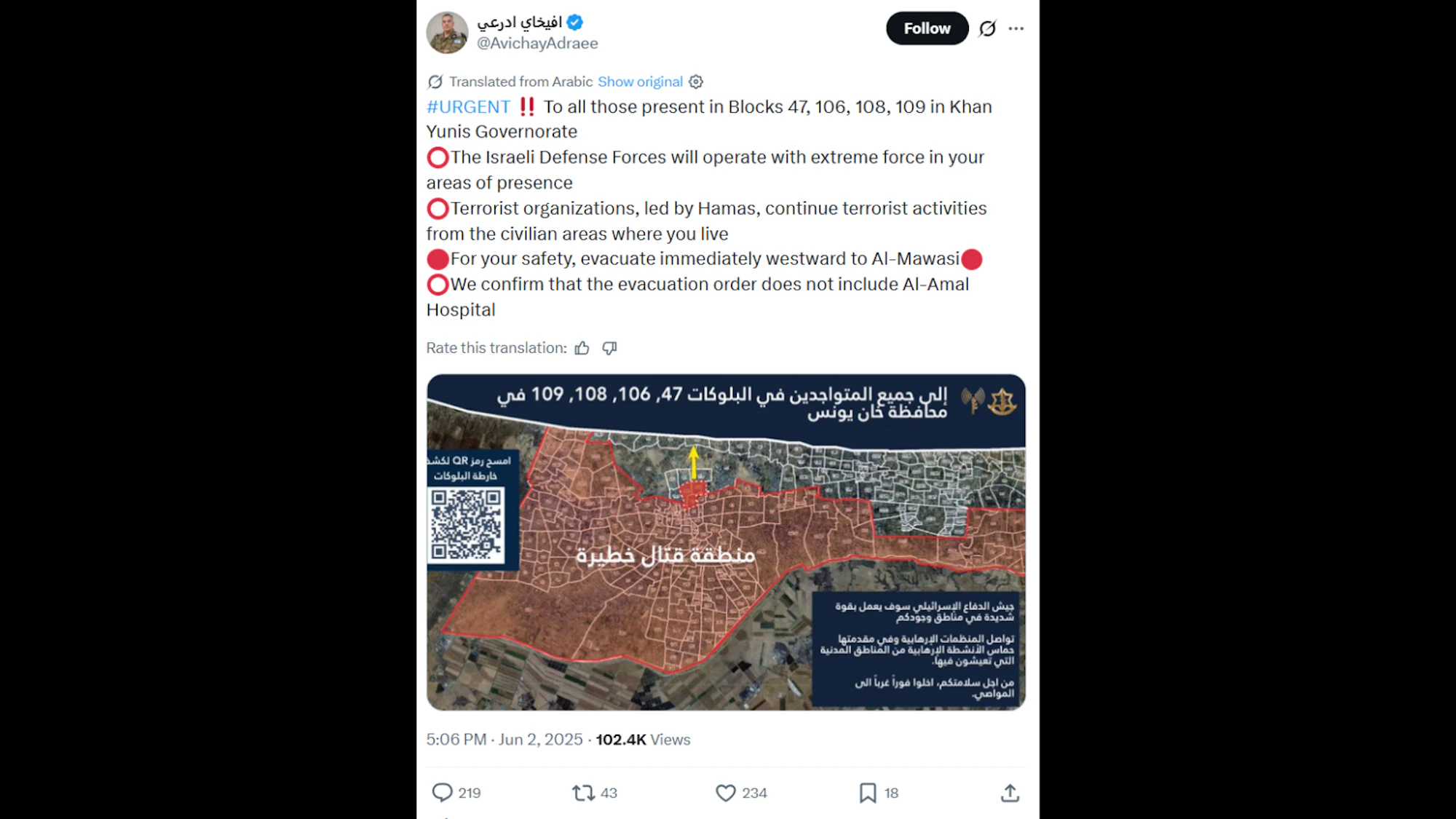
The evacuation orders themselves raised further concerns. CIR found that orders were issued on average every 2.8 days across the period, with 13 published after 22:00 local time. In the week following the January ceasefire, seven orders were issued in seven days; four gave no destination, and one showed a directional arrow contradicting the text. During a 12-day period in June, eight separate orders covered 267 blocks, 43% of Gaza’s total. CIR assessed that this volume and pace of instructions likely caused confusion among civilians trying to identify where it was safe to move.

Evacuation order posted by IDF spokesman Avichay Adraee. Source:  X  

During the ceasefire period, from 19 January to 18 March 2025, the buffer zone remained in place, covering a minimum of 63km², and displacement orders continued to be issued. Seven orders were published across the ceasefire period, with the buffer zone expanding on at least one occasion even before hostilities resumed.  

Crucially, the language of those orders differed markedly from those issued during active fighting. They made no mention of Hamas or militant activity as a justification; instead they warned civilians against approaching areas where IDF forces were stationed, with repeated instructions that “approaching the forces stationed in the sector puts you in danger.” CIR assessed that this suggests the orders during the ceasefire were issued to serve Israeli strategic objectives rather than to protect civilians, and that the continued maintenance of the buffer zone during a cessation of hostilities points to displacement that extended beyond the immediate demands of military operations. 

No safe option

What the evidence supports, in CIR’s assessment, is that from January to July 2025, civilians across most of Gaza were effectively left with no safe option: ordered out of their homes under threat of force, directed toward areas that were themselves subject to military activity, unable to return to neighbourhoods that had in many cases been demolished, and increasingly cut off from the water, food, and basic infrastructure on which survival depends.

Download the full reports to find out more:

Latest reports, direct to your inbox

Be the first to know when we release new reports - subscribe below for instant notifications.

Share Article