Targeting Gaza's hospitals: mapping the systematic destruction of healthcare

9 min read

CIR

CIR 's photo

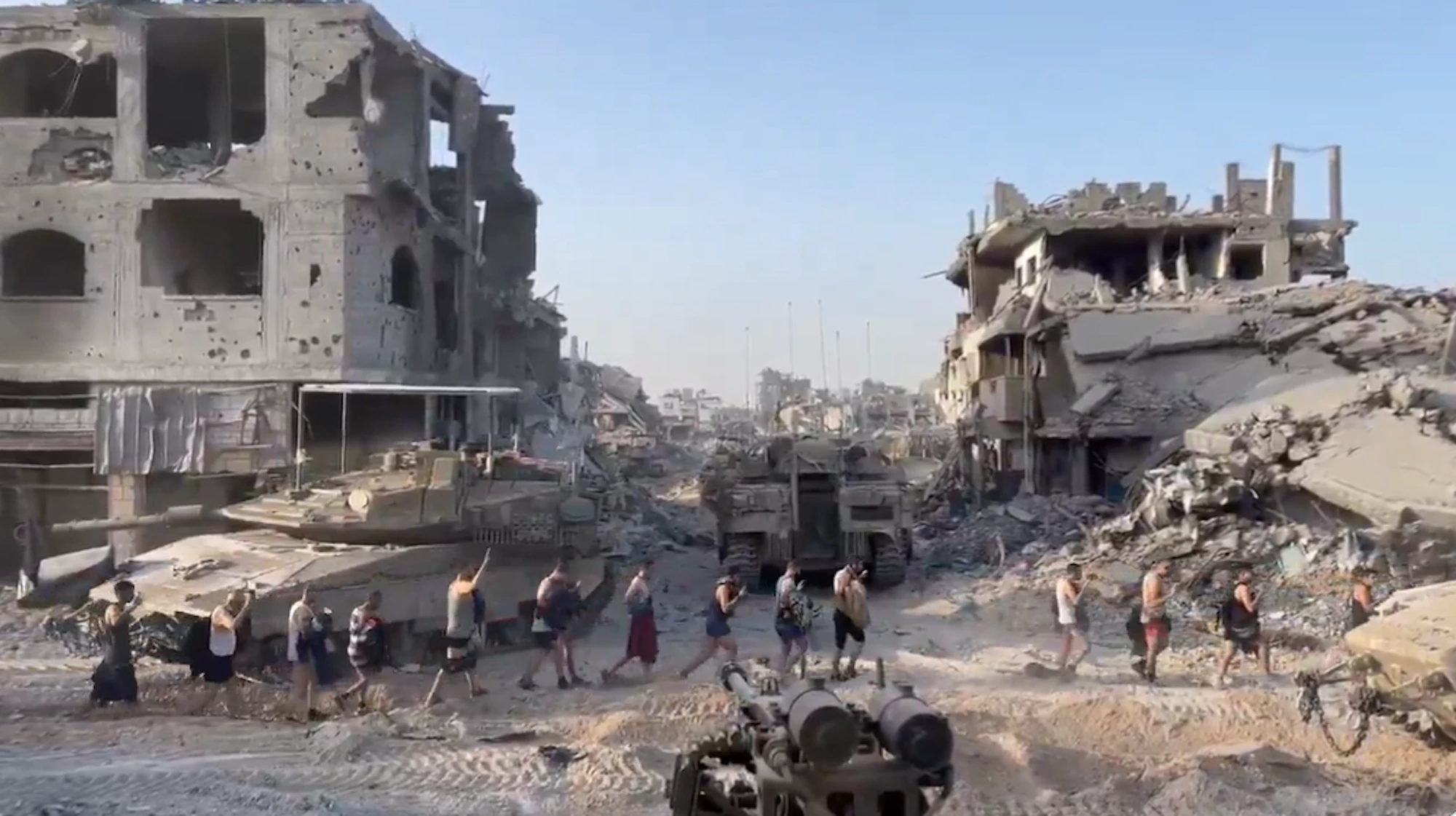
Still from footage reportedly showing doctors and patients walking on foot out of Kamal Adwan Hospital when it was stormed by the IDF. Source: Quds News Network

Share Article

Drawing on more than two years of open-source investigations, CIR has mapped verified incidents of strikes, sieges, demolitions, sniper fire, and the systematic destruction of medical infrastructure across Gaza’s hospitals. This article brings that evidence together into a single account of the dismantling of Gaza’s healthcare system.

This article contains links to and descriptions of footage showing damage to healthcare facilities, casualties, and the aftermath of strikes and demolitions. Some content is graphic.

On the morning of 5 June 2025, journalists were working in the courtyard of Al-Ahli Arab Baptist Hospital in Gaza Old City when a strike hit without warning. CIR verified footage showing at least 13 casualties, 12 adults and one minor, in the moments that followed, with medical staff rushing to carry the wounded to a medical tent. Middle East Eye reported that at least four Palestinian journalists were killed: Suleiman Hajjaj and Ismail Badah of Palestine Today TV, Samir al-Rifai of the Shams News Agency, and Ahmed Qaljah of Al-Arabiya TV. A fifth, Imad Daloul, was critically injured. A ‘PRESS’ vest was visible at the scene.

The Israel Defence Forces (IDF) stated it had carried out a targeted strike on a militant who was allegedly operating a command complex in the hospital’s courtyard. CIR could not independently verify whether any militant group was operating in the area.

That same day, the World Health Organisation (WHO) stated that Gaza’s health system was “collapsing”. This was not a sudden development, but a deterioration CIR had been documenting for eighteen months prior.

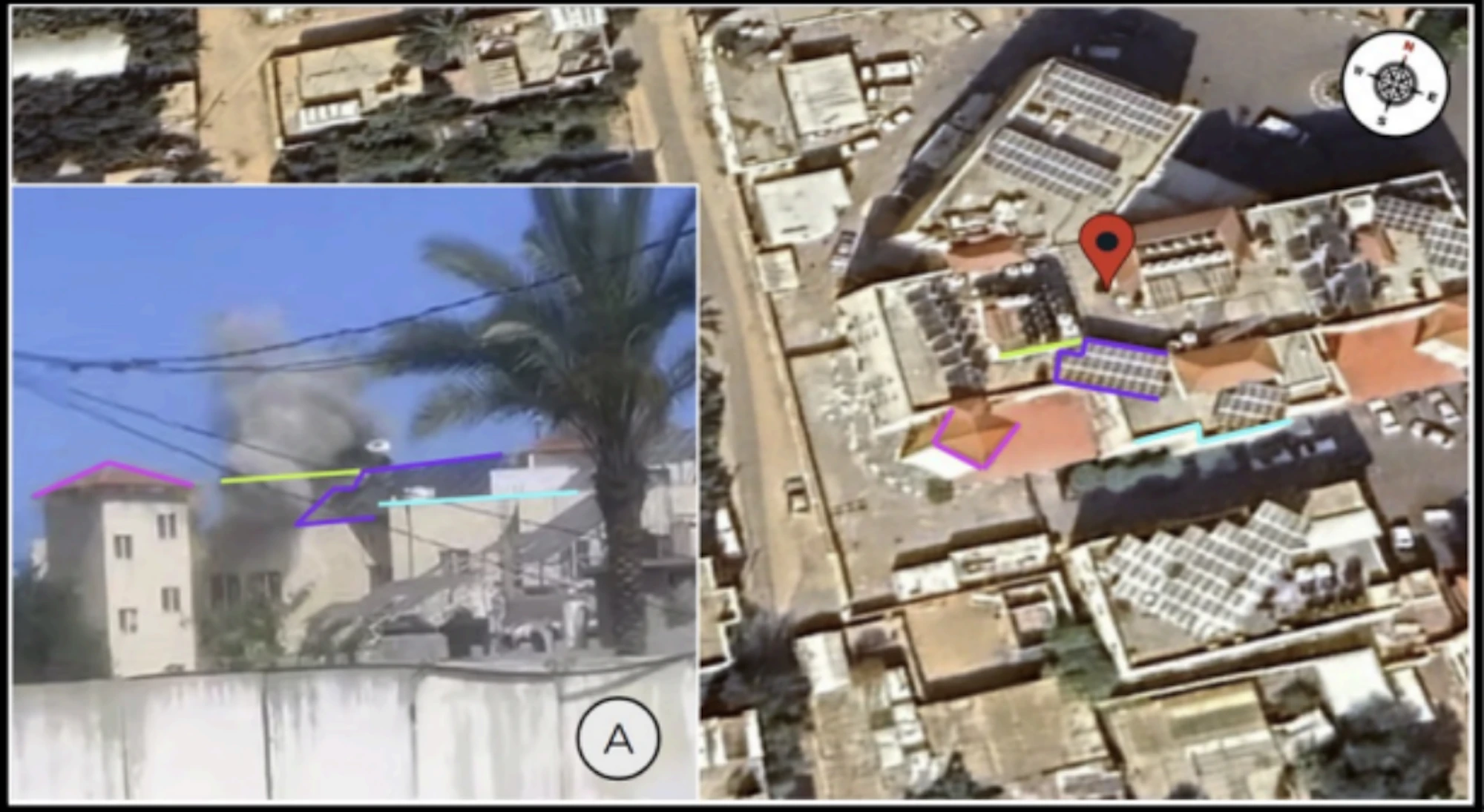
CIR’s geolocation of IPIN3138, showing casualties at Al-Ahli Arab Baptist Hospital, Gaza City, at coordinates 31.5048, 34.4614. Sources: Google Earth Pro, X, Instagram.

Mapping the destruction

This article draws on CIR’s investigations into incidents at Gazan hospitals between January 2024 and June 2025; a body of work including dedicated reports on Al Amal Hospital, Nasser Medical Complex, Kamal Adwan Hospital, Al Shifa Hospital, and the most recent cluster of incidents documented in CIR’s June 2025 incidents report. Taken together, the evidence documents a consistent pattern: hospitals struck, besieged, and demolished; medical staff detained, killed, and displaced; and specialist equipment like dialysis machines, oxygen lines, and generators, repeatedly destroyed. 

The IDF has, in several cases, claimed responsibility, justifying strikes on the grounds that Hamas were using facilities as command and control centres or weapons stockpiles. To assess these claims, CIR applied its open-source methodology to each incident, cross-referencing user-generated content (UGC) with satellite imagery and analysing metadata to verify the timing and location of events. Across the cases examined here, CIR did not find independently verifiable evidence of militant presence at the hospital sites themselves at the time of the attacks.

Taken together, the incidents documented here point to a pattern of sustained damage to Gaza’s healthcare infrastructure. 


Khan Younis, January 2024

CIR’s hospital investigations began with Al Amal Hospital in Khan Younis, the headquarters of the Palestinian Red Crescent Society (PRCS), clearly marked with the Red Crescent emblem on its roof and sheltering approximately 14,000 internally displaced persons. On 2 January 2024, two strikes hit the building within thirty minutes of each other, early in the morning. CIR verified at least three of the five casualties reported by the PRCS.

Damage to Al Amal Hospital/PRCS Headquarters, Khan Younis, geolocated to 31.3518, 34.2977. Sources: PRCS X account, Google Earth Pro, PRCS Instagram.

Gemma Connell, a United Nations Office for the Coordination of Humanitarian Affairs (UNOCHA) official who was present at the scene, described the area where she was standing as somewhere “where babies were living.” Among the casualties, according to several media outlets, was a five-day-old infant.

The IDF did not publicly claim the strikes. The IDF Spokespersons Unit told The Times of Israel that an internal investigation had been launched. CIR could not verify responsibility from the available footage.

Satellite imagery and footage analysis indicate that the PRCS compound, where internally displaced persons (IDPs) were sheltering at the time, had been struck repeatedly in the days prior to the 2 January attack. CIR geolocated strikes within 500m of the building in late December 2023, including one on 27 December directly across the street from the hospital, which reportedly killed 20 individuals. The 2 January strikes were the latest in a sequence of incidents that had been steadily closing in on the compound.

Satellite imagery from Planet shows IDP activity around the Al Amal Hospital/PRCS Headquarters on 19 December 2023, indicating the possible presence of tent encampments on the grounds of the hospital

Nasser Medical Complex: 34 incidents in three months

Shortly after the Al Amal strikes, Israeli forces launched a formal siege of Nasser Medical Complex; the largest hospital in southern Gaza, comprising Nasser Hospital, the Nasser Emergency Department, and Mubarak Hospital. Between 6 February and 30 April 2024, CIR verified 34 separate incidents at or within 150 metres of the complex. It represents one of the most densely documented episodes of conflict at a single medical facility in CIR’s dataset.

CIR verified a total of 34 incidents at and in the vicinity of Nasser Medical Complex, including content showing armed activity, human impact, and damage sustained. Source: Airbus satellite imagery.

The scale of military activity was significant. CIR verified IDF Merkava tanks entering the compound on 15 February 2024, footage of an armoured Caterpillar 966 bulldozer crushing a vehicle inside the grounds, and the presence of at least 24 armed soldiers within the complex. The IDF Commander of the Southern Command, Major General Yaron Finkelman, was geolocated conducting a situation assessment approximately 150m from the hospital’s emergency department. Multiple soldiers claimed to belong to the Shayetet 13 Naval Commando unit, though CIR was unable to verify this independently.

The human impact was severe. CIR verified eight incidents showing alleged sniper-related casualties at or around the hospital gates: including, on 13 February 2024, a deceased minor outside the hospital’s eastern entrance. Medical staff were documented coming under fire while attempting to retrieve injured individuals from the drop-off zone. CIR verified footage of at least nine stripped and blindfolded detainees alongside IDF soldiers inside the grounds. The BBC reported that medical workers told them they had been “blindfolded, detained, forced to strip and repeatedly beaten by Israeli troops.” CIR could not independently verify those testimonies, but the available footage confirms the presence of detained individuals.

CIR verified footage of an individual in white overalls and a yellow headband inside and nearby Nasser Hospital and later deceased in a body bag. Sources: Google Maps; X & Telegram.

By April 2024, mass graves had been discovered within the complex’s grounds. Palestinian officials reported exhuming over 280 bodies, some with hands tied. The IDF denied burying Palestinian bodies but acknowledged conducting an “examination” of the site. CIR verified footage of at least 29 shrouded bodies at two separate grave sites within the compound, and separately geolocated an excavator removing remains from one of them. 

Physical damage to the complex was extensive. CIR verified a large fire engulfing the Nasser Emergency Department on 28 February 2024. By April, footage showed debris-filled corridors, damaged equipment, and blown-out windows throughout the emergency wing. Al Jazeera alleged the fire had been caused by Israeli artillery; CIR could not confirm this. Despite the damage, health partners announced efforts to restore core services in May 2024, a recovery that would prove short-lived.


Kamal Adwan Hospital: the last hospital in northern Gaza

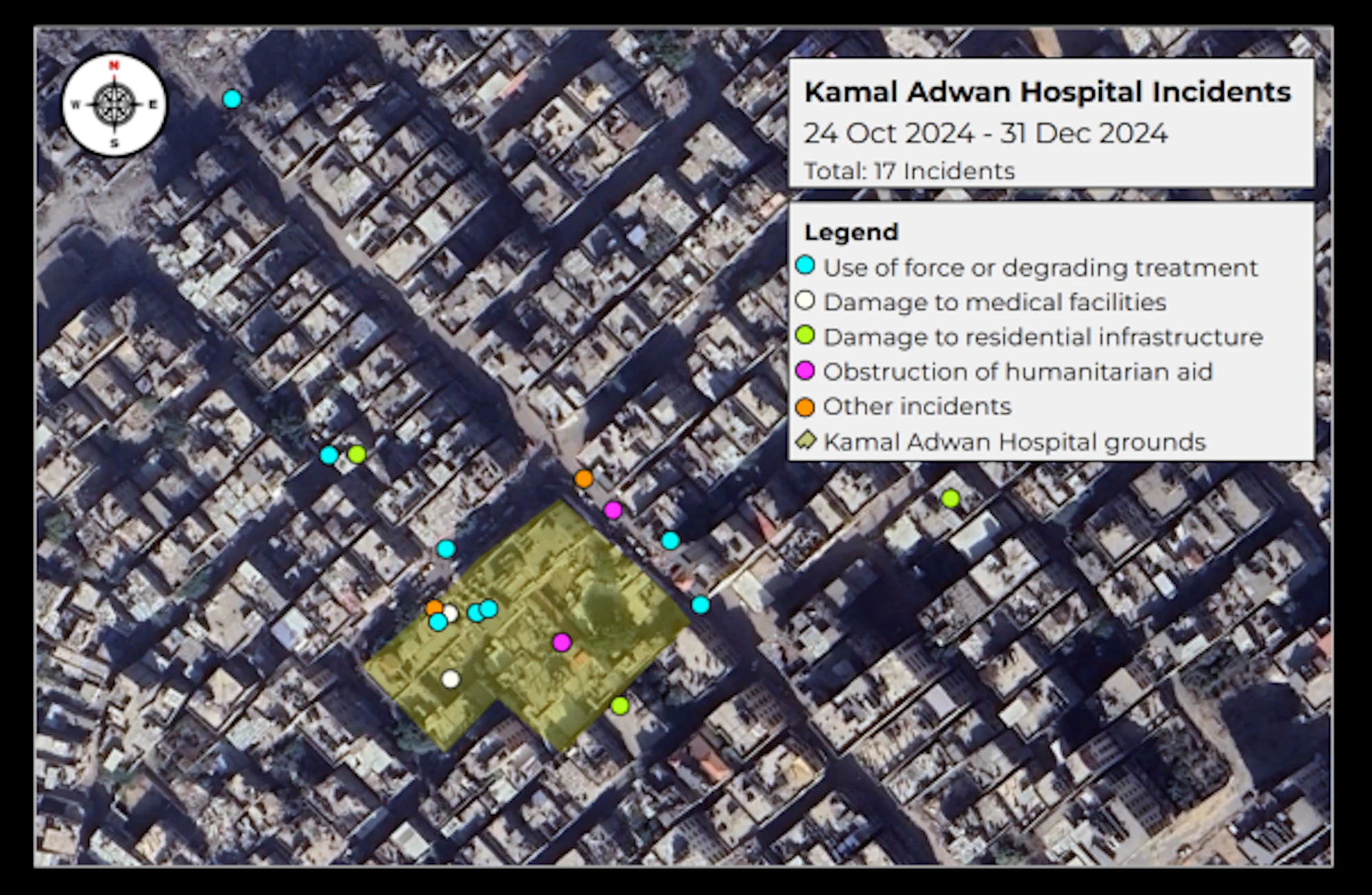
In Beit Lahia, northern Gaza, Kamal Adwan Hospital was the subject of CIR’s most extensive single-facility investigation. The hospital had been the subject of verified incidents since December 2023, when the Gazan Ministry of Health reported that 2,500 displaced persons sheltering there had been forced to leave and over 70 medical staff detained. CIR’s January 2025 report covered 17 verified incidents between October and December 2024 alone.

Map showing the 17 incidents verified by CIR at Kamal Adwan Hospital or within a 200m vicinity. Source: Google Earth Pro.

Military activity over these months took the form of a sustained siege that escalated significantly through the final weeks of 2024. It began on 25 October, when the IDF announced its forces were operating in the area, having stated it had facilitated the evacuation of patients prior to the operation.

On 26 October, CIR verified footage showing eight possible casualties covered in white cloth and blankets in the hospital courtyard, with an IDF Merkava Mk IV MBT tank visible outside the courtyard walls as heavy gunfire was audible and smoke filled the courtyard. Multiple unarmed individuals, including Dr Safiya, were observed leaving the building holding makeshift white flags. Further verified footage from the same day showed two Merkava tanks, a Caterpillar 966 wheeled loader, four APCs, and at least five armed soldiers within the hospital’s grounds. The footage also shows extensive damage to the hospital and nearby residential buildings.

Still from footage posted of possible casualties in Kamal Adwan hospital courtyard. Source: X 

Dr Safiya and the Gazan Health Ministry stated that Israeli forces had entered the compound twice in 24 hours and opened fire; Al Jazeera reported that IDF troops had targeted the hospital’s oxygen system and generators, allegedly causing the deaths of two babies. The Gazan Health Ministry recorded the detention of 44 male staff members. On 28 October, the IDF stated it had “apprehended approximately 100 terrorists from the compound.”

On 19 November, CIR verified imagery of at least 20 individuals stripped to their underwear and blindfolded in the hospital’s courtyard alongside at least 18 armed soldiers. On 24 November, Dr. Safiya was reportedly injured in a drone strike on the hospital. Three days later, the head of the hospital’s Intensive Care Unit, Ahmed Al-Kahlout, was reportedly killed by a drone; Reuters reported that the Israeli military said it was unaware of a strike at that location or time. 

On 5 December, CIR verified footage of at least two casualties in the hospital courtyard, including a minor in a wheelchair. The following day, a PRCS ambulance came under automatic weapons fire at the hospital’s northern gate. On 21 December, an IDF APC deposited a large steel box marked ‘Danger’ at the hospital’s northern gate using a roller system. Media reports alleged it contained an explosive-laden robot; CIR could not verify an explosion from available footage.

On 26 December, footage showed Dr Safiya being led into an IDF armoured vehicle; an IDF statement confirmed he was “among the suspects taken for questioning.” The following day, CIR verified at least 25 individuals, many partially undressed with hands in the air, walking in single file near IDF tanks approximately 190 metres from the hospital. 

CIR’s geolocation of footage showing at least 25 individuals walking with their hands in the air in the presence of IDF military vehicles. Sources: Google Earth Pro, X.

On 28 December, the IDF published a statement claiming that its “Targeted operation against a Hamas command centre in the Kamal Adwan Hospital” had been completed and that “The forces apprehended over 240 terrorists in the area.” The same day, the WHO confirmed that Kamal Adwan was out of service. No hospitals remained functional in northern Gaza.


May-June 2025: a system at breaking point

By May 2025, the enclave was relying on just two functioning public hospitals. Between 13 May and 4 June 2025, CIR verified eight incidents at six hospital sites across four governorates. 

On 13 May, two hospitals in Khan Younis were struck within hours of each other. At the already damaged Nasser Medical Complex, CIR verified at least two adult casualties and significant structural damage. The IDF claimed the strike had targeted senior Hamas operatives inside the hospital. Among those reported killed was Palestinian journalist Hassan Eslaih, who had been receiving treatment in the hospital’s burn unit for injuries sustained in an earlier Israeli strike on a media tent beside the building. 

CIR’s geolocation of damage to the European Hospital, Khan Younis, Gaza, at coordinates: 31.3029, 34.3207. Sources: Google Earth Pro, X, Telegram.

At the European Hospital, six kilometres to the south, CCTV captured at least four sequential explosions in and around the courtyard. Al Jazeera reported at least 16 people killed and 70 wounded. The IDF said it had targeted a Hamas command complex in an underground network beneath the hospital. No evacuation order was reported at either site.

Six days later, Nasser Medical Complex was struck again, this time a warehouse on the complex’s north side, built in 2024 with support from the King Salman Aid and Relief Centre and stocked with intravenous fluids, syringes, and dialysis solutions bearing logos from UNICEF, Medical Aid for Palestinians, and the WHO. The WHO confirmed approximately 30% of the warehouse and its supplies were destroyed.

In Beit Lahia, CIR documented the Indonesian Hospital on fire on 19 May, with medical sources reporting that IDF forces had targeted the facility’s power generators, and then physically demolished by excavator on 4 June, alongside a Merkava tank and Namer APC.

CIR’s geolocation of IPIN3083, showing damage to the Indonesian Hospital, Beit Lahia, at coordinates 31.5353, 34.5088. Sources: Google Earth Pro, Telegram.

Less than 200m away, the Noura al-Kaabi Dialysis Centre, the only kidney treatment facility in northern Gaza, which was serving tens of thousands of patients, was destroyed on 1 June 2025 by multiple excavators alongside IDF armoured vehicles. Before its destruction, only eight dialysis machines reportedly remained operational. No IDF statement on the dialysis centre was identified.

On 4 June, CIR verified a drone detonating on the roof of Al-Aqsa Hospital in Deir al-Balah, within the al-Mawasi humanitarian zone. The Palestinian Information Centre reported at least three such detonations within an hour, causing panic among patients and the thousands of displaced persons sheltering there. The following morning came the strike on Al-Ahli Arab Baptist Hospital that opened this article.

CIR’s geolocation of IPIN3134, showing an explosion on the Al-Aqsa Hospital roof, Deir al-Balah, Gaza, at coordinates: 31.4197, 34.3597. Sources: Google Earth Pro, links available upon request.

What eighteen months of open-source evidence shows

The facilities documented across CIR’s investigations served different functions in different areas of Gaza. What connects them is that each was damaged or destroyed at a time when they were among the last functioning healthcare options available to the surrounding population.

The IDF has offered a consistent justification across these incidents, namely that hospitals were being used by Hamas for command and operational infrastructure. CIR has applied the same evidential standard to each case to assess whether the available material can independently substantiate those claims. In the cases examined here, it cannot.

What open-source analysis does establish is the following. Over eighteen months, hospitals across Gaza have been struck by airstrikes, entered by ground forces, fired upon by snipers and drones, and in several cases physically demolished. Medical staff have been killed, detained, and displaced. Essential infrastructure has been degraded or destroyed. Facility after facility has been rendered non-functional, leaving Gaza’s population without proper medical care in what is still an active conflict


If you would like to find out more information about any of these incidents. Please reach out to [email protected] 

Latest reports, direct to your inbox

Be the first to know when we release new reports - subscribe below for instant notifications.

Share Article