Myanmar military-led election Phase 3: Delayed voting does not mean safer elections

5 min read
Myanmar Witness


“Nationwide fighting undermines Myanmar election credibility: social media users”, Mizzima Myanmar News and Insight, January 26, 2026. Source: Mizzima
Note: This report references military websites that may be unsafe to access without a VPN.
Myanmar Witness documented 111 conflict-related incidents across the townships designated for Phase 3 voting – the highest number across all election phases. Within the studied timeframe (August – November 2025), 20 of the 63 “stable” Phase 3 townships reported at least one incident, and these events appeared more clustered within fewer townships than in Phase 1 and Phase 2.
Despite this pattern aligning with state narratives that Phase 3 areas were scheduled later for voting due to potential higher security risks, Myanmar Witness’s findings suggest that phasing has not reduced conflict-related threats in areas deemed safe to vote.
Notably, Ayeyarwady and Yangon were the only participating regions in Phase 3 that reported no incidents. This reflects their lower levels of documented conflict since the 2021 coup.
This is Myanmar’s first election process since the coup, and is being referred to as the ‘2025 Multi-Party Democratic General Election’. Phase 1 of the voting process began on 28 December 2025, Phase 2 on 11 January 2026, and Phase 3 on 25 January 2026. Voting was limited to townships officially designated as “stable” by Myanmar’s military authority, the Union Election Commission.
To note: The list of townships participating in each phase was taken from English publications on Myanmar government websites and the Global New Light of Myanmar (GNLM), a state-run media platform. Several inconsistencies were found and corrected by cross-referencing with the Data 4 Myanmar map.
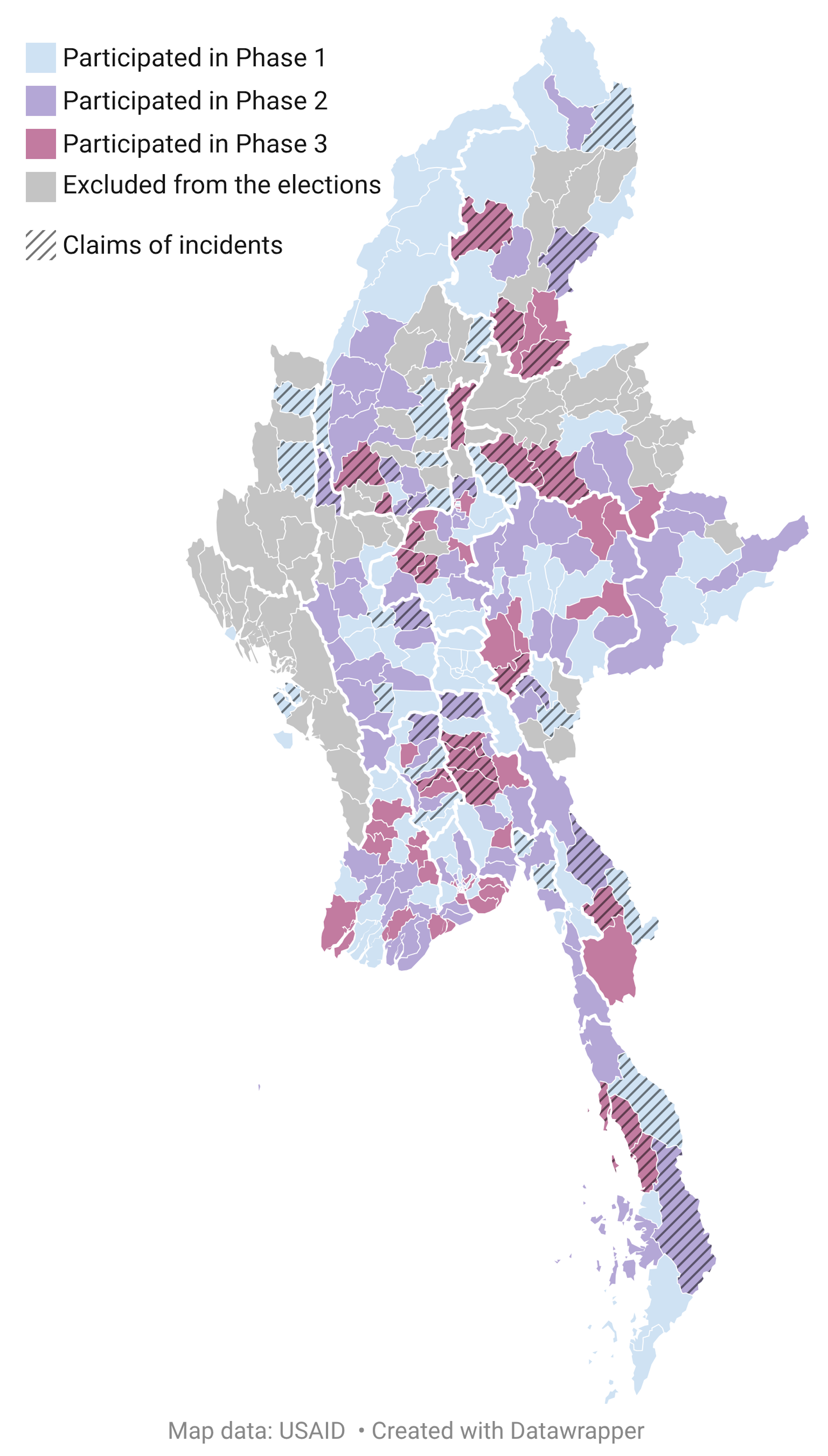
Figure 1: Myanmar Witness’s map of townships by election phase and participation status, along with recorded conflict-related incidents occurring in townships in Phases 1, 2 and 3 (source: Map created by Myanmar Witness on Datawrapper).
Analysis by state
Myanmar Witness’s analysis shows that two participating regions – Yangon and Ayeyarwady – had no Phase 3 townships with recorded conflict-related incidents. In contrast, participating states that did record incidents experienced multiple events, indicating that insecurity in Phase 3 remained uneven and concentrated in specific areas rather than evenly distributed.
Moreover, several states did not participate in Phase 3 because all of their designated “stable” townships were already covered in Phase 1 and Phase 2. These include Nay Pyi Taw, Mon State, Kayah State, and Mandalay Region. Chin and Rakhine States were also partially covered in earlier phases, to the extent that the military allowed their participation. However, large sections of both states remain excluded from the electoral process, as no voting sites were designated, leaving more than 75% of their townships without local voting access.
Sagaing, a region with a long-standing record of conflict dynamics since the coup, had two townships participate in Phase 3, and conflict-related incidents were documented in both. The same pattern was observed in Tanintharyi, where the three participating townships also recorded such incidents. In contrast, Mandalay, Kayin, Kachin, and Bago had more townships participating, with at least half of them reporting conflict-related events.
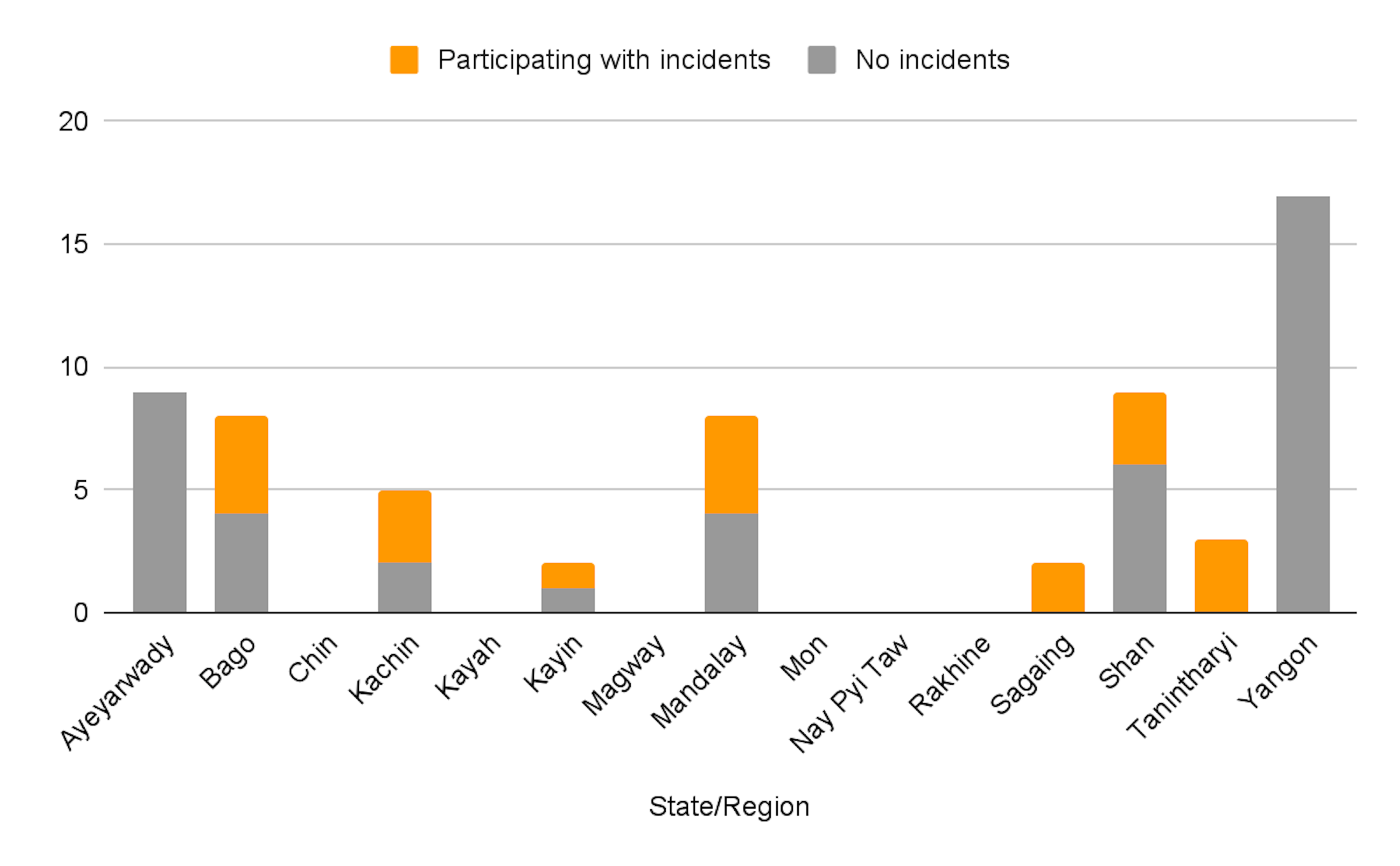
Figure: Myanmar Witness’s graph shows the varying levels of recorded incidents across participating townships in the Myanmar Phase 3 electoral process. The graph illustrates that Sagaing and Tanintharyi regions had an incident in each participating township.
The graph below illustrates the ranking of states and regions by the number of townships included in Phases 1 [grey], 2 [orange], and 3 [red]. This analysis highlights the uneven inclusion between states and regions and shows which ones were largely excluded from the overall electoral process.
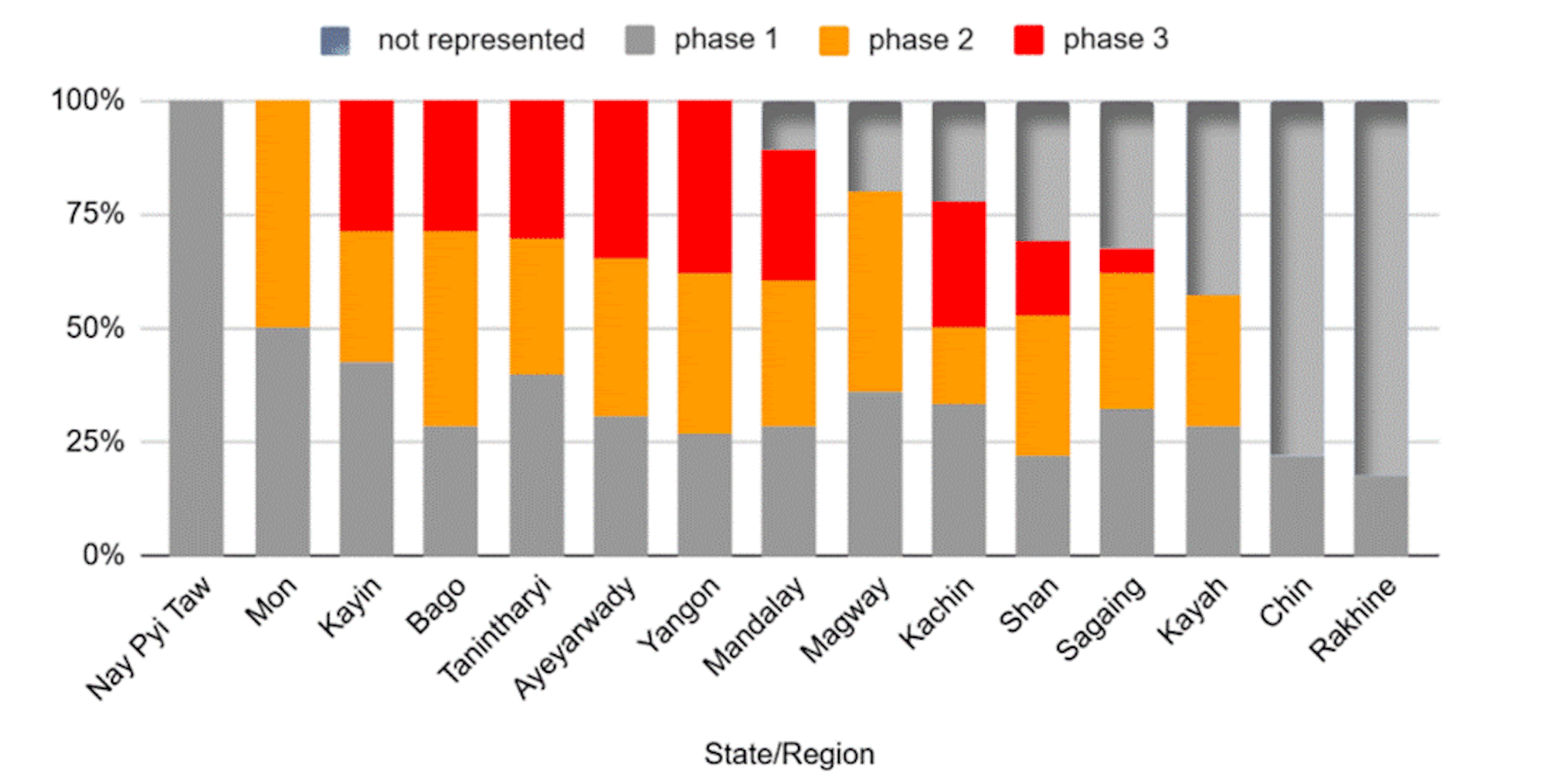
Figure: Myanmar Witness graph ranking states/regions by the number of townships included in Phase 1 (grey), Phase 2 (orange), and Phase 3 (red) of the voting process.
The table below expands on this, showing the Phase 3 participating townships, highlighting significant differences in both participation and security challenges. A full breakdown is available upon request.
| State/Region | Total Townships | Townships in Phase 3 | Townships with recorded incidents | % of Phase 2 Townships with incidents | Incident Types |
| Ayeyardwady Region | 26 | 9 | 0 | 0.00% | No reviewed claims/reports recorded |
| Bago Region | 28 | 8 | 4 | 50.00% | Casualties, drone incidents |
| Chin State | 9 | 0 | 0 | 0.00% | Townships are not participating in Phase 3 |
| Kachin State | 18 | 5 | 3 | 60.00% | Airstrikes, landmines, fire, casualties, drone incidents |
| Kayah State | 7 | 0 | 0 | 0.00% | Townships are not participating in Phase 3 |
| Kayin State | 7 | 2 | 1 | 50.00% | Airstrike, fire, casualties |
| Magway Region | 25 | 0 | 0 | 0.00% | Townships are not participating in Phase 3 |
| Mandalay Region | 28 | 8 | 4 | 50.00% | Airstrikes, fire, casualties, paramotor incidents, drone incidents. |
| Mon State | 10 | 0 | 0 | 0.00% | Townships are not participating in Phase 3 |
| Nay Pyi Taw | 8 | 0 | 0 | 0.00% | Townships are not participating in Phase 3 |
| Rakhine State | 17 | 0 | 0 | 0.00% | Townships are not participating in Phase 3 |
| Sagaing Region | 37 | 2 | 2 | 100.00% | Airstrikes, casualties, and paramotor incidents |
| Shan State | 55 | 9 | 3 | 33.33% | Airstrike, landmines, fire casualties, paramotor incidents, drone incidents |
| Tanintharyi Region | 10 | 3 | 3 | 100.00% | Airstrikes, fires, casualties, drone incidents. |
| Yangon Region | 45 | 17 | 0 | 0.00% | No reviewed claims/reports recorded |
Myanmar Witness’s documentation of recorded incidents across states and regions, regardless of Phase 3 inclusion, suggests that the designation of “stable” townships is a relative assessment rather than the absence of recent conflict, since some continued to experience incidents.
Analysis by theme
Airstrikes
Myanmar Witness recorded claimed airstrikes in 10 townships selected for Phase 3 voting between August and November 2025. This highlights how, despite the delay in participation, these areas continued to experience aerial attacks, and calls into question whether later voter scheduling meaningfully reduced exposure to violence for civilians and voters. These airstrikes are often attributed to the Myanmar military.
Fires
Fires were documented in 11 townships selected for Phase 3 of the election. Fire incidents resulting from either military operations or armed clashes affect homes and livelihoods in Myanmar. These notably have some overlap with airstrikes.
Casualties
Myanmar Witness documented incidents resulting in casualties across 14 townships selected for Phase 3 voting. This highlights that significant risks were placed on civilians that persisted despite the delay in voting participation.
Landmines
Alleged incidents of landmine activity were recorded in three townships selected to vote in Phase 3. Even the suspected presence of landmines can restrict civilian movement on roads, farmland, and village pathways, hindering campaigning and voter outreach. This further complicates and limits participation while reinforcing political disengagement, even in areas officially deemed as “stable”.
Paramotors
In 2025, paramotors became a more widely cited part of the conflict in Myanmar, and seem primarily to be used by the Myanmar military. Paramotor-related incidents were recorded in three Phase 3 townships. For many voters, especially in rural areas, the risks associated with movement under aerial threat may outweigh the perceived benefits of participating in the electoral process, particularly where political participation has already been restricted in the period leading up to elections.
Drones
Myanmar Witness recorded claimed drone incidents in eight townships in Phase 3. Even when drone-related incidents are infrequent, their presence within the months preceding voting has the potential to cultivate fear, causing civilians to avoid public gatherings, travel, and participation in religious, educational, or political activities. This highlights how aerial surveillance or attacks may suppress political engagement, despite townships being officially designated as “stable”.
Conclusion
Myanmar Witness documented 111 conflict-related incidents in townships designated as “stable” places of voting in Phase 3 of the elections, challenging the military’s narrative of safe electoral spaces. Even though these townships were planned as the final Phase 3 areas and given extra time to prepare, the recorded incidents suggest that safe and conscious voting could not be guaranteed.
Latest reports, direct to your inbox
Be the first to know when we release new reports - subscribe below for instant notifications.