Myanmar's protected religious sites devastated by airstrikes

7 min read
Myanmar Witness

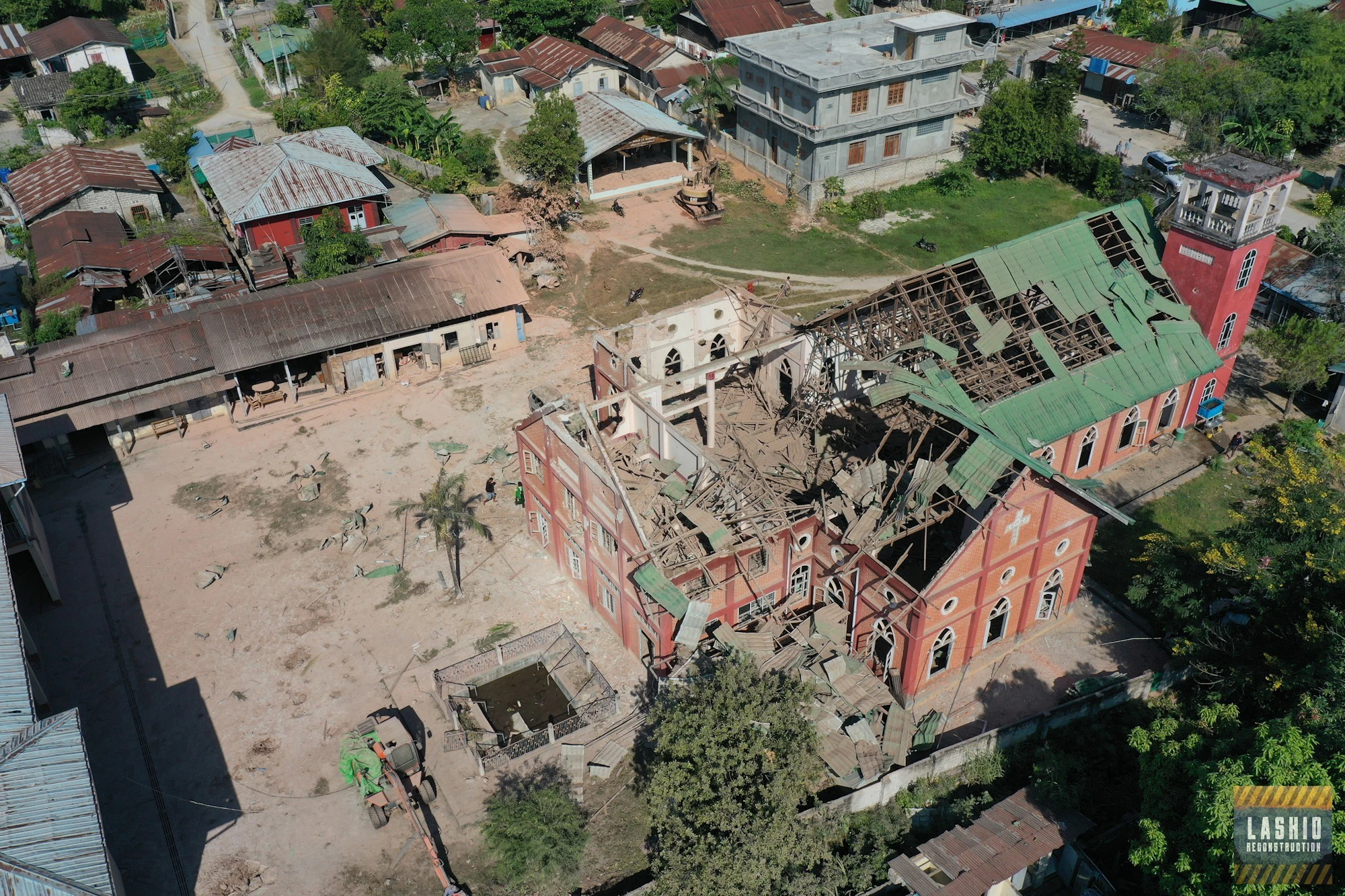
A church destroyed in Hseni town, Hseni Township, Shan State, following a reported airstrike in 2024 (Source: Lashio Reconstruction via Facebook)
Key findings include:
- Geographic scope: 13 of 15 regions/states reported incidents – excluding Naypyidaw Union Territory and Yangon Region.
- Sagaing Region and Shan State recorded the highest numbers with 57 each, followed by Mandalay Region with 53 incidents.
- Of 330 townships, 108 (33%) were affected. Natogyi in Mandalay Region had the highest at 17, followed by Kyaukme in Shan State with 15 and Taungtha in Mandalay Region with 12.
- Temporal trends: 177 incidents (57%) occurred in 2025, and 135 (43%) were recorded in 2024.
- February 2025 reached a peak with 27 incidents (around one per day).
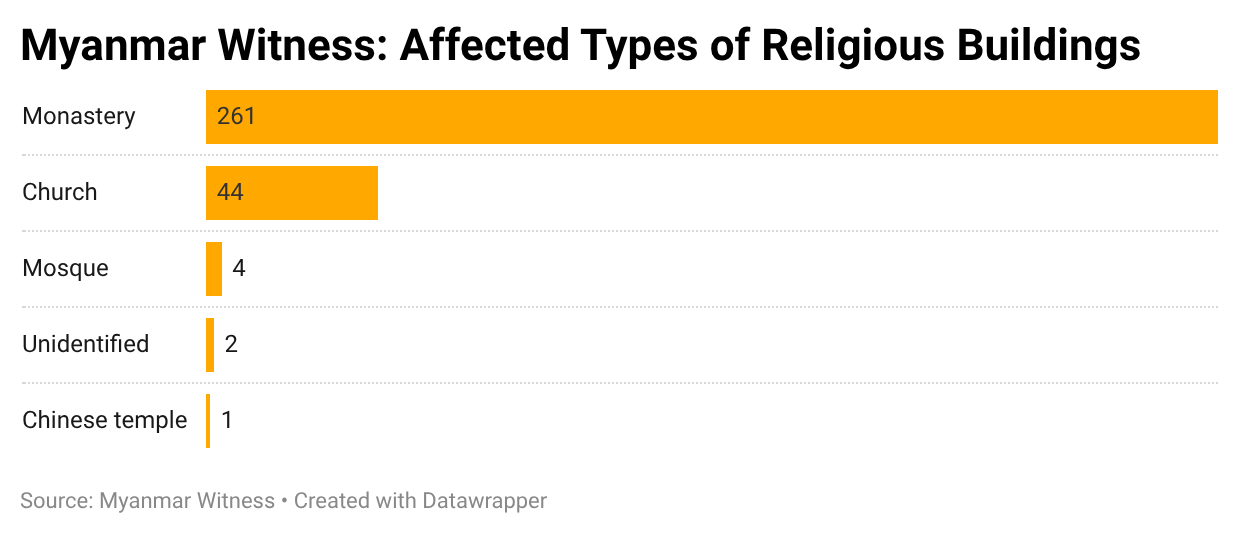
- Building types: Monasteries dominated with 261 instances documented out of 312 (84%), followed by churches at 44 (13%).
- Damage severity: Major damage was the most commonly recorded under 126 incidents (40%), followed by complete destruction with 77 (25%).
- Damage causes: Explosions were documented in 251 incidents (80%), 209 of which – 67% – also impacted surrounding areas. Explosions and fire were documented in 25 incidents (8%).
- Casualties: Across 97 incidents, 431 claimed fatalities were documented, while 871 injuries were recorded in 156 incidents. However, this figure remains unverified due to limited visual evidence.
- Geolocation: Of 312 incidents, 232 (74%) were geolocated, and 80 remain as “most likely” or claimed.
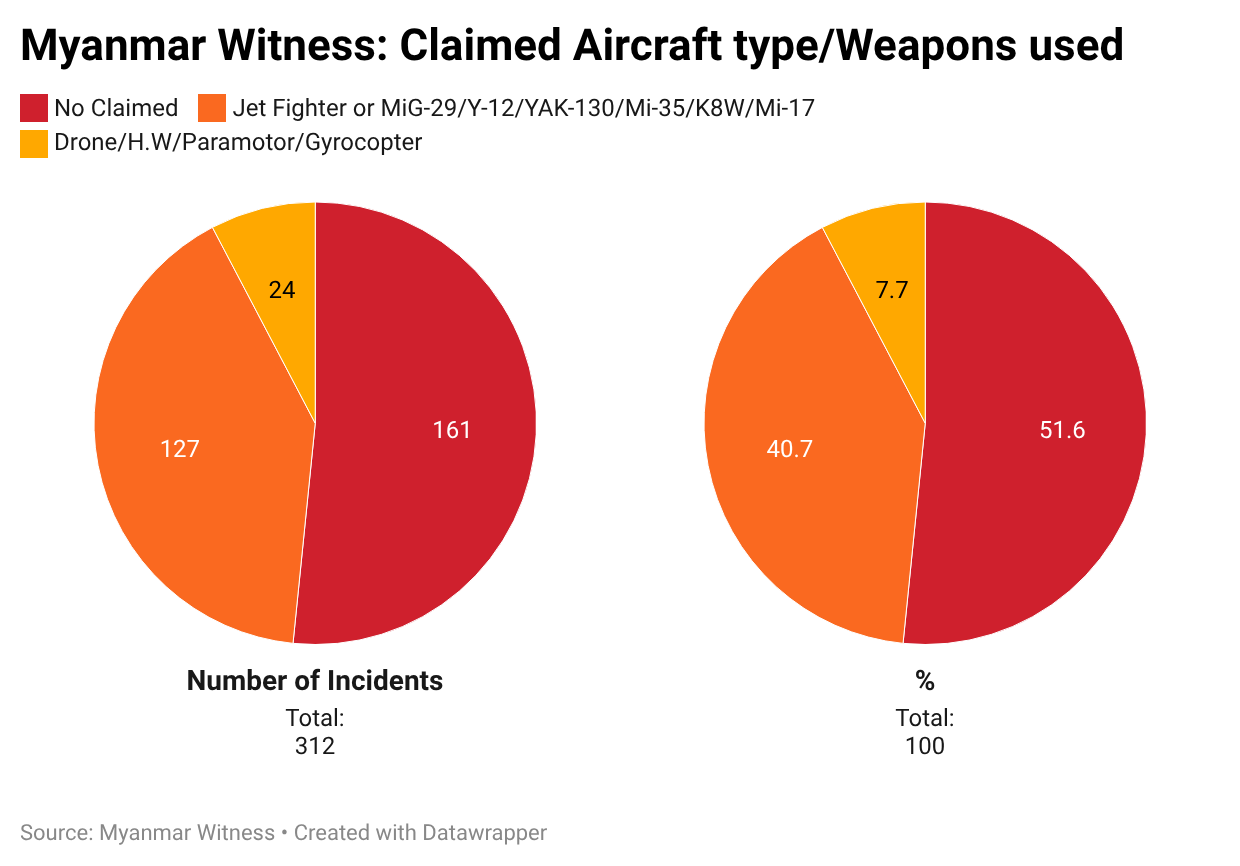
- Weaponry claims: From the dataset, jet fighters, drones, heavy weapons and paramotors were reported.
- Actors: Myanmar Air Force (MAF) was cited in 277 incidents (89%), while Ethnic Armed Organisations (EAO) were mentioned in 5 incidents (<2%), and the remainder are unknown.
While collecting airstrike incidents impacting religious buildings, Myanmar Witness’s analysis identified that education and medical facilities were also affected; this potentially indicates indiscriminate area strikes.
These findings reveal a significant pattern and rise of unsafe conditions at religious sites across Myanmar and raise questions concerning international humanitarian law. Myanmar Witness will continue to monitor and document incidents affecting these protected civilian objects.
Geographic Pattern
Geographically, the central part of Myanmar appears to experience the highest concentration of attacks. Analysis indicates that 13 out of 15 states and regions, except Naypyidaw Union Territory and Yangon Region, reported at least two incidents.
Naypyidaw is the main administrative capital of Myanmar, while Yangon is the most populous city and the main commercial centre, with major ports, banks, and businesses. The absence of reported incidents in these locations may reflect strategic decisions made by the Myanmar military to avoid key cities. Nevertheless, a lack of reports does not mean that these areas are safe from other forms of violence. The limited occurrence of attacks in these crucial areas, such as administrative and major economic regulated zones, may also influence public perception and the interpretation of conflict dynamics by the international community.
Sagaing Region and Shan State reported the highest number of incidents impacting religious buildings, with 57 each, followed by Mandalay Region with 53.
In terms of the townships, 108 out of 330 townships (33%) were impacted. Natogyi township in Mandalay Region was the most affected with 17 attacks (5%), followed by Kyaukme in Shan State with 15 (5%), and Taungtha in Mandalay Region with 12 (4%) (see figure 2 below).
Since the 2021 military coup, Sagaing Region, which is located in the central part of Myanmar, has become the epicentre of the violence. It is one of the highest conflict-impacted regions (a trend Myanmar Witness has identified in other investigations), with fire used as a method of violence. In October 2023, major clashes occurred between the Myanmar military and the Three Brotherhood Alliance, under the offensive Operation 1027. The alliance is a formation of the Arakan Army (AA), Myanmar National Democratic Alliance Army (MNDAA), and the Ta’ang National Liberation Army (TNLA).
Despite a ceasefire signed in early January 2024, with the support of China’s mediation in Shan State over these clashes, the ceasefire was violated in June 2024. The second wave of clashes began in major cities, including Kyaukme town in Shan State, as well as other locations in Mandalay Region, which were controlled by three Ethnic Armed Organisations (EAO) and the Mandalay People’s Defence Force (MDY-PDF).
The data collected and the reported presence of multiple entities fighting against the Myanmar military, highlight that Sagaing, Mandalay, and Shan State are likely major conflict zones.
Trends over Time
Myanmar Witness documented 312 airstrike incidents impacting religious buildings between 2024 and 2025, averaging approximately 13 sites per month. A year-by-year breakdown shows a slight increase in 2025, with 177 (57%) documented incidents compared to 135 (43%) in 2024. The monthly average number of affected buildings rose from 11 in 2024 to 14 in 2025. This indicates a modest escalation in reported attacks on religious sites over the year.
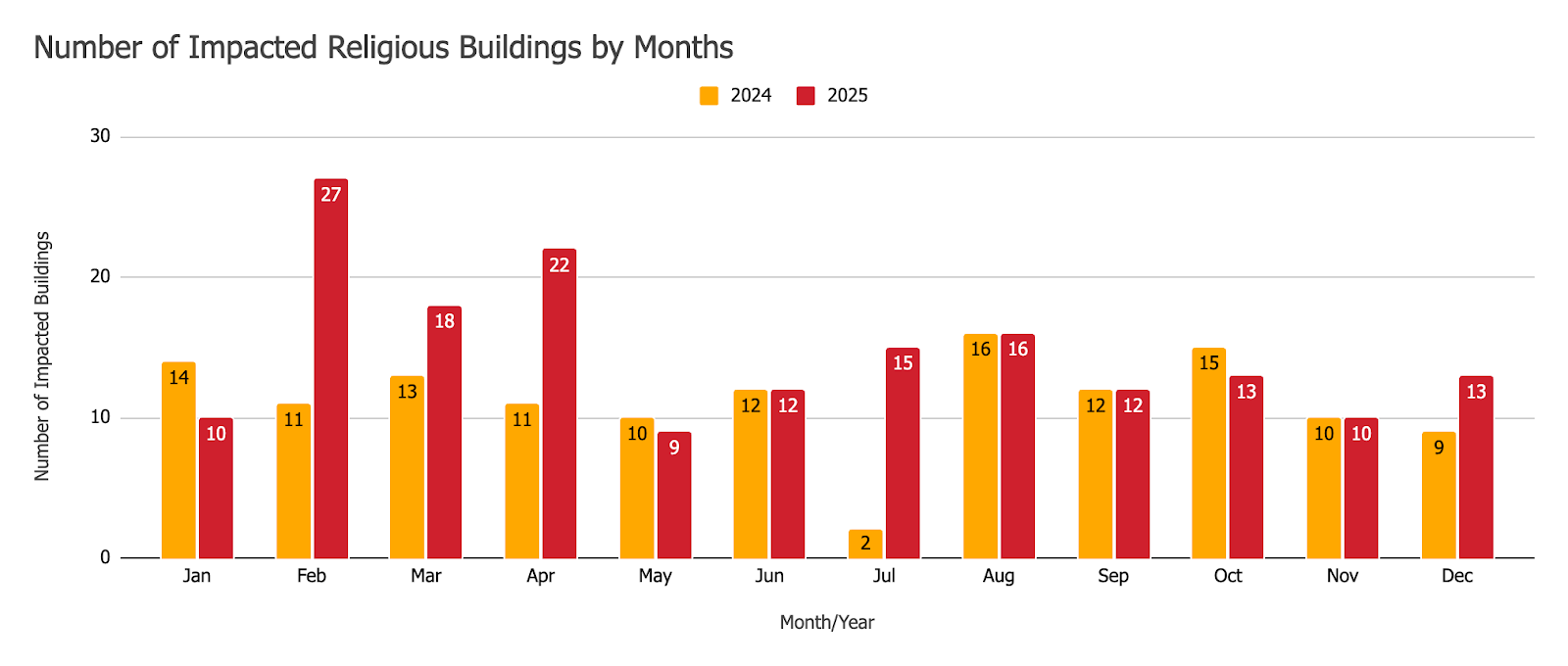
The number of reported incidents peaked in February 2025, with 27 documented, more than double the total recorded in February 2024. Of these, 11 incidents allegedly caused major damage, and seven resulted in complete destruction. Notably, no significant national events were identified in February 2025 that could account for the spike in attacks. Reported incidents occurred across the country, with all states and regions affected except Kachin State and Tanintharyi Region, indicating a relatively widespread distribution of attacks.
These statistics demonstrate that religious buildings have increasingly become common sites of reported damage, reflecting a shift in conflict dynamics in which places that traditionally are considered safe are now at heightened risk. This is despite their protection as civilian objects, and in many cases, as cultural property under international humanitarian law.
Nature & severity of damage
In Myanmar, monasteries are present in almost every village, and are visually distinct due to their architecture, large size, spacious compounds, Buddha statues and pagoda structures. Their scale also makes them frequent shelters for internally displaced persons (IDP) fleeing conflict.
Myanmar Witness analysed the different types of damaged religious buildings, the severity of damage, and the reported causes in attacks on these sites between 2024 and 2025. The data shows that monasteries recorded the majority of destruction, with 261 out of 312 affected buildings, accounting for 84% of the reported attacks between 2024 and 2025. The reported incidents also included 44 churches. Unsurprisingly, monasteries are disproportionately affected because they align with Myanmar’s demographic patterns, as Buddhists constitute 88% of Myanmar’s population, according to the 2022 Report on International Religious Freedom: Burma.
Myanmar Witness assessed the severity of damage to the religious buildings from airstrikes and categorised them under the following.
To measure the severity of damage, Myanmar Witness categorised five types:
- Not Visible: If there were only textual claims available with no footage attached
- No Damage: Craters or impacts visible on trees/ground but not on religious buildings
- Minor Damage: small holes or minimal impact visible on affected religious buildings
- Major Damage: Significant structural damage to the walls or roofs of the religious buildings
- Complete Destruction: Roofs and walls collapsed on religious buildings
The analysis shows that ‘major damage’ was the most common type recorded, affecting 126 incidents (40% of the total), and ‘complete destruction’ occurred in 77 incidents (25%). See below for an example of major damage.
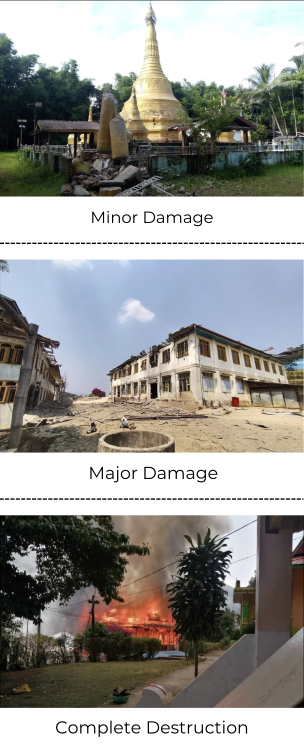
Figure: Different levels of the severity of the damage gathered from reported footage. [Top] Minor Damage: Geolocation of the damaged pagoda near Kawt Thar Su village at [16.652381, 98.121561] [Middle] Major Damage: Geolocation of the damaged monastery in Htam Yang village at [20.468014, 97.365829] [Bottom] Complete Destruction: Geolocation of the burning monastery in Pang Hlyan village at [20.734726, 97.301634] (Sources: TawNaw FM via Facebook, Pa-O Human Rights Group) via Facebook and PNLA News & Information Department via Facebook.)
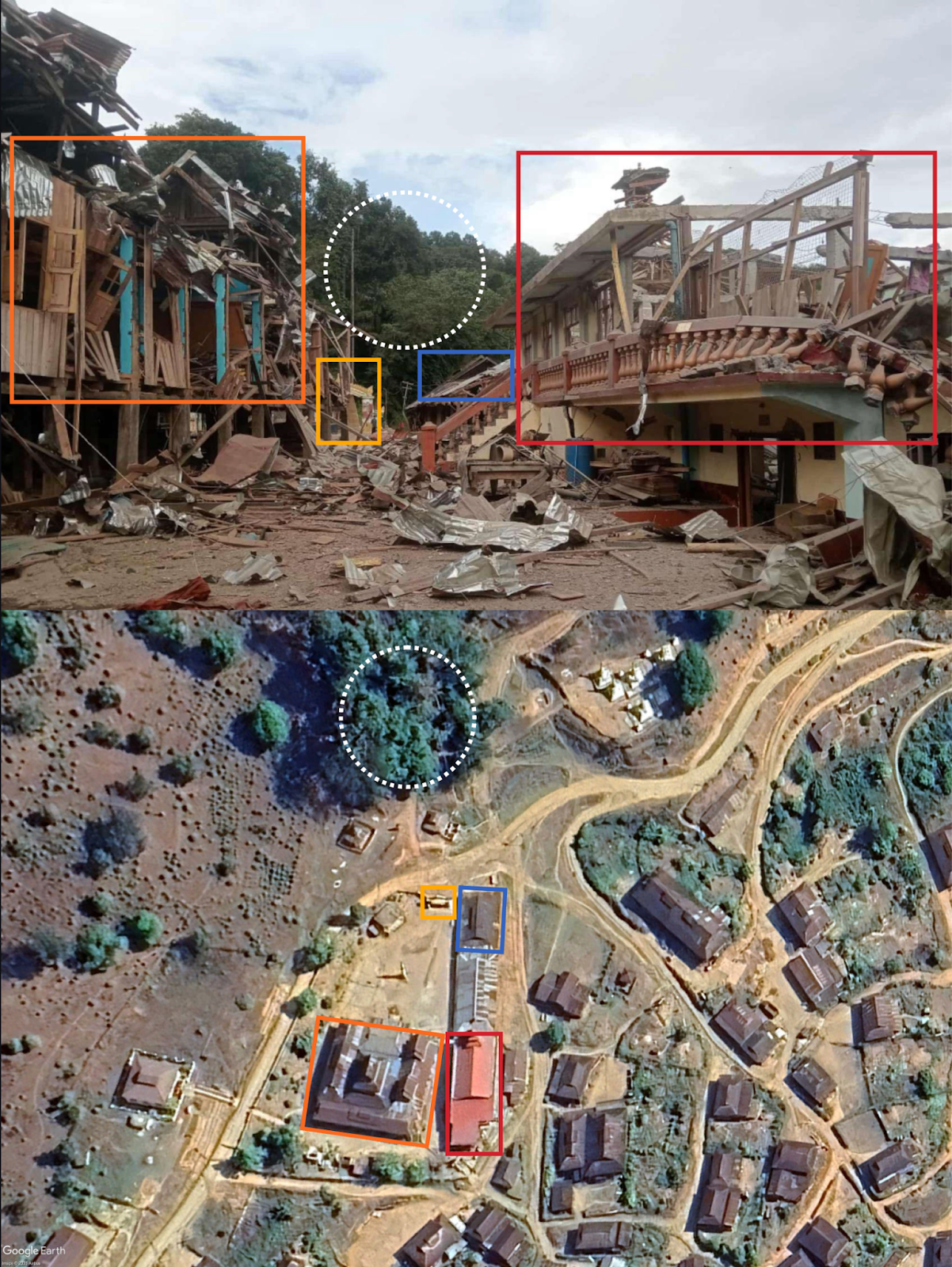
Figure: Footage showing the extent of major damage caused to a monastery reportedly from an airstrike in Kun Sa Lan village, Kyaukme township, Shan State and the damaged building at [22.852975, 96.894512] (Source: Shwe Phee Myay News Agency via Facebook)
In terms of reported causes of damage, Myanmar Witness analysed explosions, fire, and unidentified factors. Explosions were the most common cause, accounting for 251 incidents (80% of the total). Of these, 209 incidents (67%) also caused damage to the surrounding area, while 25 incidents (8%) involved both explosions and fires. These findings align with claims that airstrikes – primarily through explosive ordnance – were responsible for the majority of damage caused.
Actors
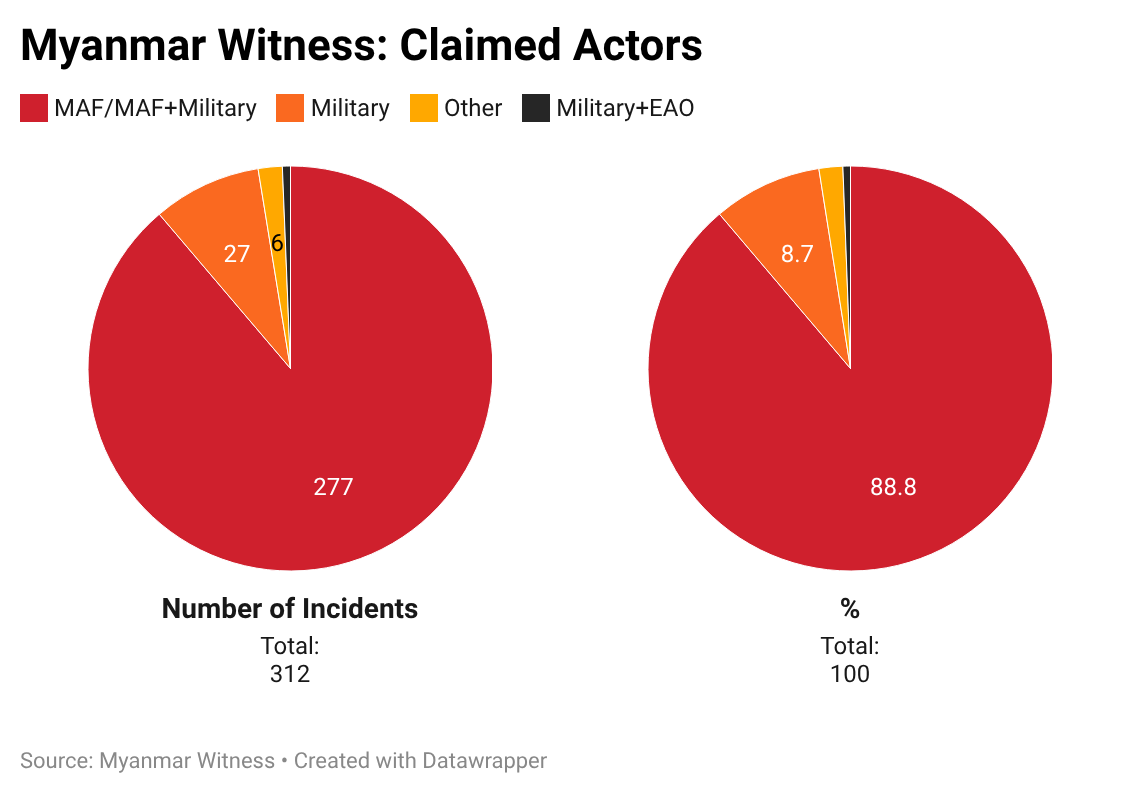
While Myanmar Witness cannot fully verify the actors responsible for reported airstrikes hitting religious buildings, the Myanmar Air Force (MAF) was cited in 277 incidents (89% of the total). This includes primary airstrikes followed by other aerial attacks involving paramotors, drones and heavy weapons across six incidents.
Aircraft claims appeared in 127 incidents (41%), and these included the use of MiG-29, Mi-35, Mi-17, Y-12, YAK-130, and K-8W (figure 8). From the incidents attributed to the MAF, 184 (66%) caused major or complete destruction. This is consistent with heavy ordnance capabilities and thus supports the damage analysis documented in this investigation.
Remaining incidents (<11%) were attributed to either Ethnic Armed Organisations (EAO), People’s Defence Forces (PDF), Pyu Saw Htee, or were unidentified (and therefore categorised as ‘other’).
Conclusion
Between 2024 and 2025, Myanmar Witness documented 312 airstrikes affecting religious buildings across Myanmar, including monasteries, churches, mosques, and temples.
With 13 of 15 states/regions impacted, these incidents highlight the heightened risk to civilians visiting religious sites. This danger is particularly acute in Sagaing Region and Shan State, which experienced the highest concentration of documented incidents.
The MAF was cited as the perpetrator in 89% of the claims, supported by further mentions of fighter aircraft in over 40% of reports and widespread explosive damage. While there was a lack of visual evidence to confirm full attribution, the MAF remains the only entity in Myanmar with access to fighter jets.
Monasteries were documented as the most affected building type. This potentially reflects their prominence in society, from their visually distinct architecture to being large enough to shelter IDPs and host community events. However, Myanmar Witness’s IDP report notes that such sites have also sometimes been used by military and resistance groups. Thus, the use of monasteries varies but demonstrates how important these sites are for local communities.
These patterns highlight the unsafe conditions at religious sites and signal an urgent need for protection measures. Myanmar Witness will continue to monitor reported incidents that affect religious buildings in Myanmar.
Latest reports, direct to your inbox
Be the first to know when we release new reports - subscribe below for instant notifications.