
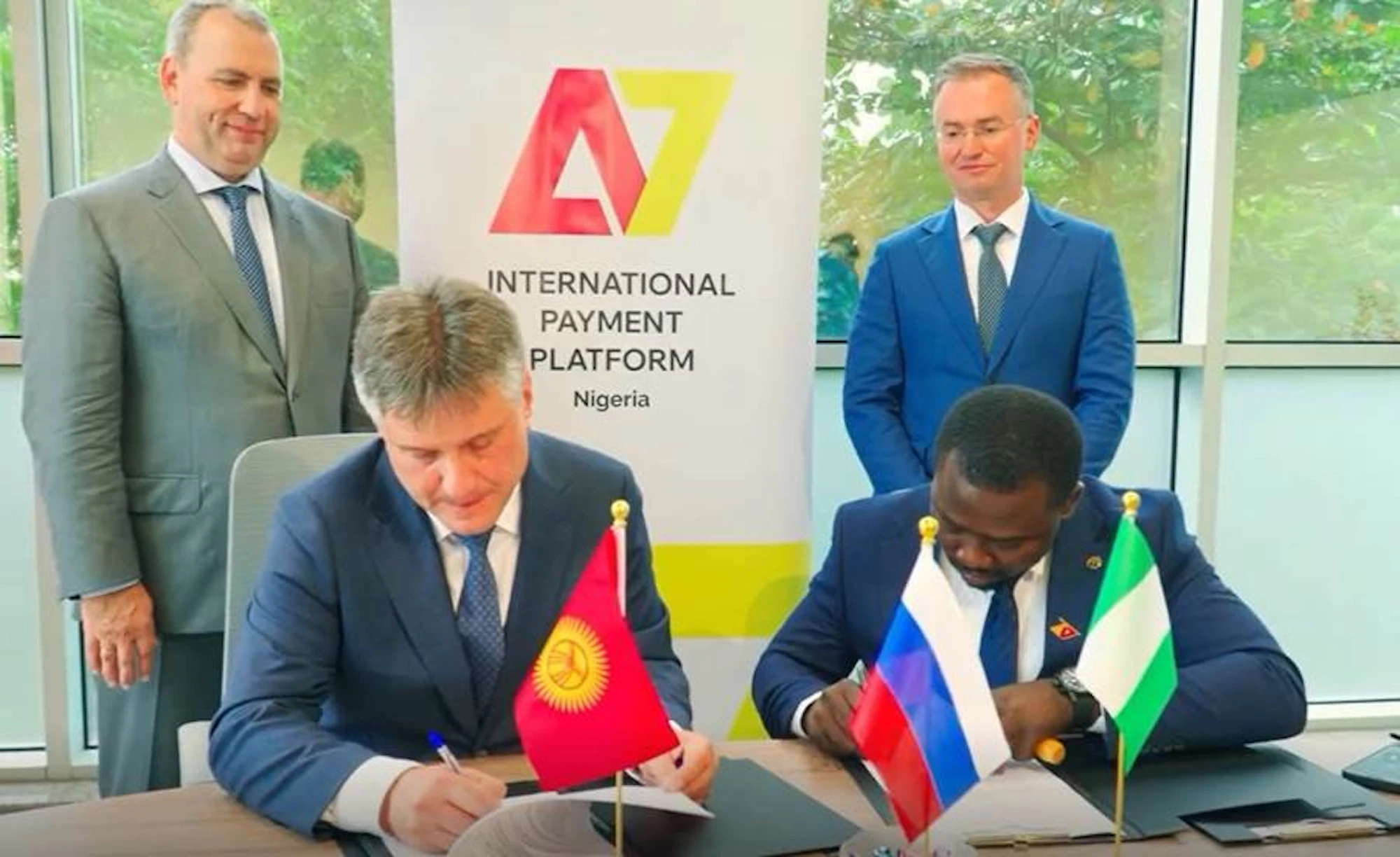
Despite being sanctioned by the US, UK and EU, Russia’s A7 network is expanding its reach in Africa, backed by the Kremlin. CIR’s latest investigation suggests A7 is entering a new phase, more directly integrated into the Kremlin’s strategic and military operations in Africa, and no longer operating purely as a commercial sanctions evasions network.
Executive summary
- Russia’s A7 sanctions evasion network, co-owned by Promsvyazbank and Ilan Shor and sanctioned by the US, UK and EU, announced its first publicfacing international offices in Nigeria and Zimbabwe in September 2025. The offices were officially opened by Russian Deputy Finance Minister Ivan Chebeskov and Promsvyazbank Deputy Chairman Mikhail Dorofeev.
- Russian media reported that the openings were attended by the respective Finance Ministers of Nigeria and Zimbabwe, the latter of whom was visible in images of the event. Asked about A7 by the media, Nigerian Finance Minister Wale Edun said he did not attend, but such an event may have taken place in Lagos.
- CIR has found and analysed footage from the opening ceremony of A7’s Nigerian office. Among the handful of guests who attended, CIR has identified Belarusian businessman Alexander Zingman and two of his known business associates as well as, former Moldovan MP Igor Khimich, an ally of A7 CEO and co-owner Ilan Shor, in attendance.
- A7 Nigeria appears to be operating on the ground via a local partner, Pilot Finance Limited. Companies have been registered in Kyrgyzstan in the names A7 Africa and A7 Nigeria, owned by Nigerian businessman Chidiebere Emmanuel Ajaere.
- A delegation likely linked to A7, including Deputy Chairman Dorofeev and Igor Khimich, appears to have made undisclosed visits to Togo and Madagascar in January 2026. This comes amid a major uptick in diplomatic and military cooperation between the Russian government and these two countries, including the arrival of Russia’s Africa Corps in Madagascar. In late March A7 began advertising for a Country Manager for Togo.
- These developments may indicate that A7’s operation is entering a new phase in which it is more directly integrated into the machinery of the Kremlin’s strategic and military operations internationally. This has implications for the nature of the risks posed by A7’s network and for the responses necessary to combat them.