On 1 December, the RSF captured the 22nd Division base in Babanusa, West Kordofan, after signalling their advance online and carrying out a destructive assault verified by satellite imagery and multiple videos. The takeover consolidated RSF control in western Sudan and restricted civilian reporting, raising concerns over further moves toward SAF-held areas.
Key findings
- On 1 December, the Rapid Support Forces (RSF) took over the 22nd Division base in Babanusa, West Kordofan. The takeover occurred just a month after their successful capture of El Fasher, North Darfur, on 27 October 2025.
- CIR verified footage of RSF units entering the city from multiple directions in November, supported by reinforcements from East Darfur.
- The RSF forces had signalled plans to capture the 22nd Division base in Babanusa via social media on 9 November. Satellite imagery from 9 November and 10 November showed Babanusa was impacted by fire and destruction during the RSF’s advance.
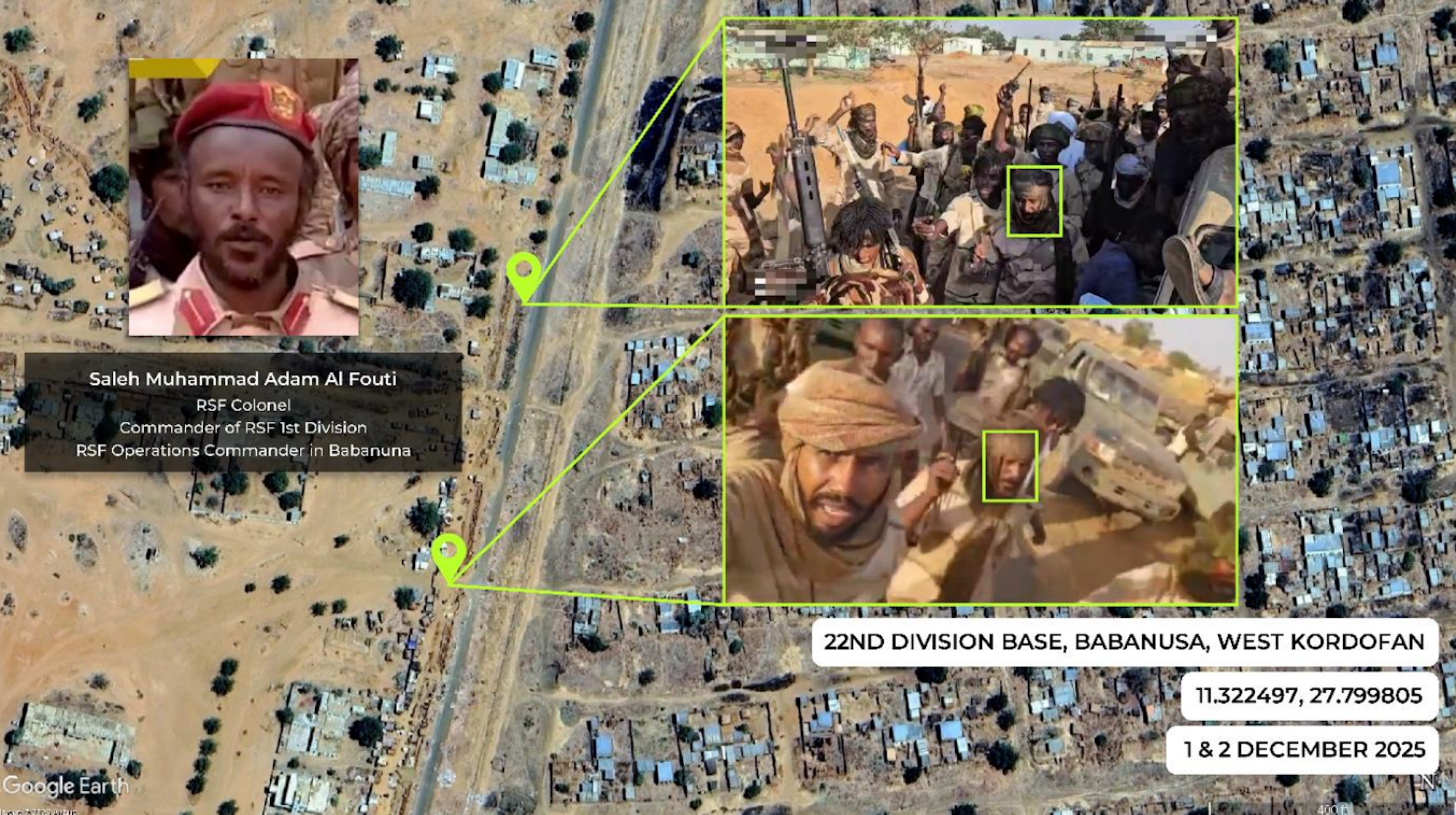
- RSF Colonel Saleh Muhammad Adam Al Fouti, commander of the RSF’s 1st Division in Nyala, was verified in multiple videos in Babanusa, including in footage from 1 December showing him at the base gate and on 2 December delivering a speech at the northeastern end of the base.
- After the takeover, local civilian media and independent online reporting sharply declined, leaving RSF as the primary source of updates from the area. This suggests civilians were unable to share information online, and that the RSF controlled the information space at the time of writing this report.
- Control of the base extends RSF dominance in western Sudan and could facilitate further moves toward SAF-held Kordofan locations, including El Obeid, capital of North Kordofan.
RSF threats to take over the 22nd division base
On 9 November, the official RSF Telegram channel posted a video in which RSF fighters declared their intention to seize control of the 22nd Division base in Babanusa, West Kordofan, following their takeover of El Fasher in October. RSF fighters from East Darfur claimed in a separate video that they had been deployed to Kordofan, seemingly as part of the advance.
Between 9 and 10 November, NASA FIRMS and Planet satellite imagery respectively detected extensive heat signatures and active fires across residential neighbourhoods in Babanusa, consistent with escalating conflict in the area. Comparative analysis of Planet imagery from before and after the takeover revealed significant damage to northern parts of the city.
On 11 November, a pro-RSF Telegram account posted video footage showing fighters at the gate of Peace University. CIR verified this footage, confirming RSF forces’ presence on the eastern side of Babanusa.
Clashes between RSF and opposing forces continued in the city, with the RSF announcing on 15 November that the capture of the 22nd Division base was imminent.
Verification of takeover of 22nd division base
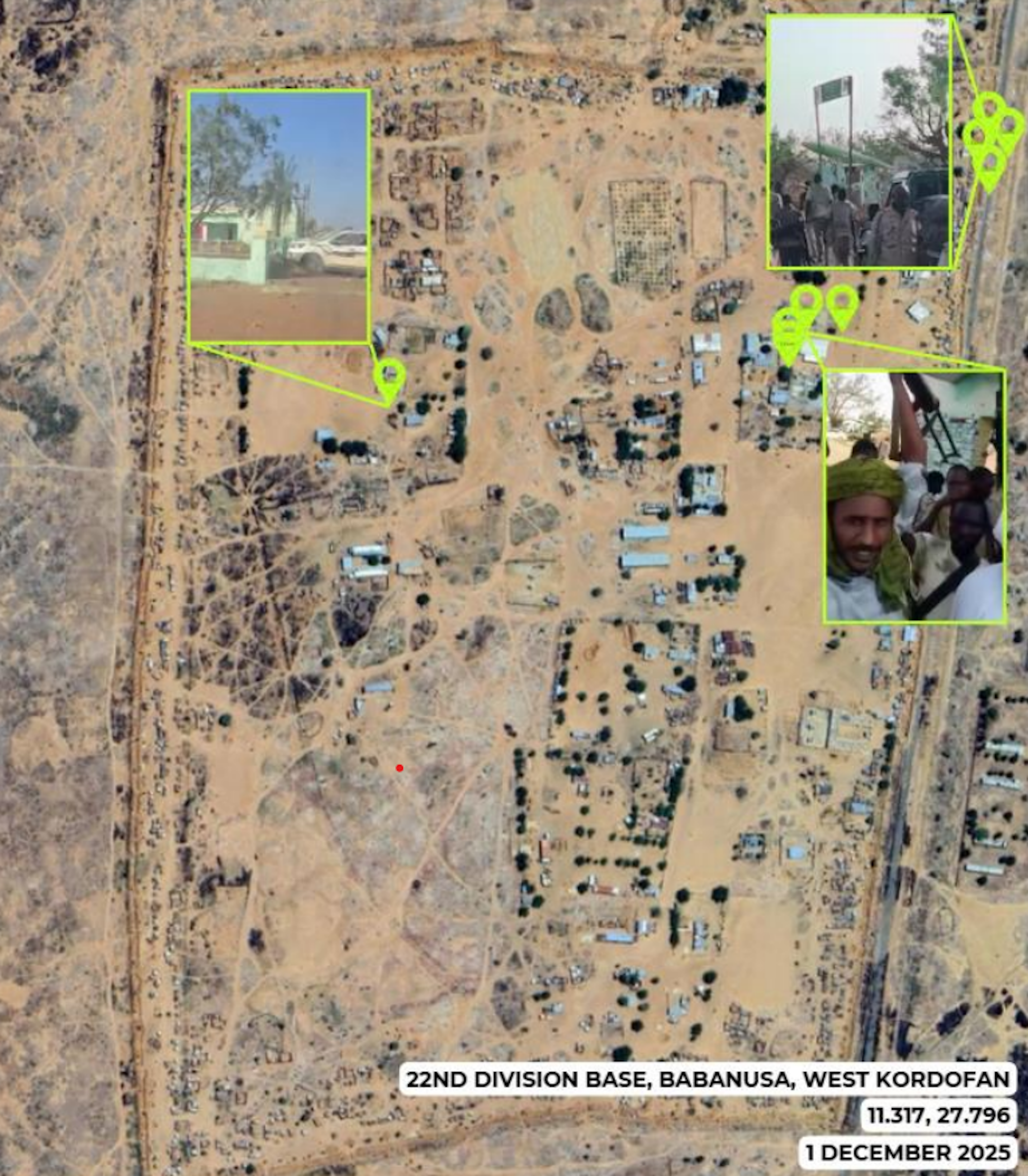
On 1 December, the RSF announced on Telegram that they had taken over the 22nd Division base in Babanusa. CIR confirmed the takeover and geolocated nine videos posted by pro-RSF Telegram channels on 1 December showing RSF soldiers at multiple locations inside the 22nd Division base in Babanusa, including at the gate, northeastern corner and western side. This confirmed that RSF forces were positioned throughout the perimeter of the base, indicating a takeover in progress.
Another video posted on 1 December, to a pro-RSF Telegram channel. shows footage filmed from an RSF vehicle. CIR geolocated this video to the western side of the base, confirming that RSF forces had breached the perimeter (figure 1).
Other videos circulating on Telegram on 1 December show a heavy RSF presence on the B38 road, which runs parallel to the base. One video posted to a pro-RSF Telegram channel on 1 December shows a large convoy of RSF vehicles outside the front gate of the base (figure 1).
A further video shared to the same pro-RSF Telegram channel on 1 December shows RSF fighters on foot and celebrating next to buildings on the northeastern side of the base (figure 1). The behaviour of the fighters suggests that there was likely no remaining threat from SAF elements inside the base or in the immediate surroundings of the base.